09
Sep 26

Give me an inch, I’ll want the whole calendar

I could do so much … or at least get so much done … if I had more time. If I didn’t have other things to do. Also if I didn’t read so much news. Also, if I woke up earlier. This would require my falling asleep earlier, but there was work to do last … and early this morning. Also, I could sleep in, which seemed like a delightful idea when I pulled up the covers in the a.m. hours. I was OK with it when I woke up, mid-morning too. Then, I did the work that needed doing. Finished freestyling some class materials, waded through the email, tread water with the news. Had lunch, read a page or two from a book. But!

But if I had more time in a day to do all of the things I want to do, I could do half of the things I need to do and one-quarter of what I’d like.

I think about that a lot. I think about that a lot because I actually have a a bit of free time. The problem, as ever, is that I’d like more, and I need it to come in large blocks — I’m talking large chunks: 24, 72, 744 hours — rather than a little here, and a little there, later.

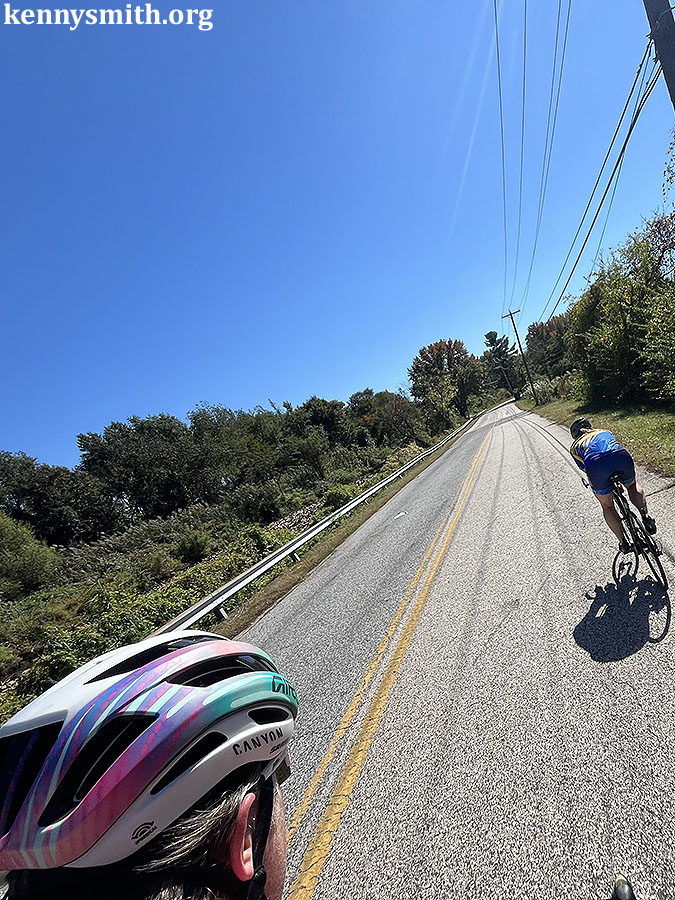
For instance, I wanted to get in a bike ride today before class. And because of my timing, and the above, I had enough time for an hour. That’s essentially a long loop around the neighborhood. I rode the four miles into town, and then by the park, and the sheep farms. Took a left in the next crossroads town, and then a right away from there off into the real countryside, just watching the clock tick by on my computer as I wondered, not for the first time, why that particular road vexes me so. I turned before the winery, pointing down into a creek bed, and then up two little hills, to the sod farm.

I enjoyed the misting.

We ride through irrigation setups from time-to-time around here. I always wonder what is spraying me. Hopefully it was water today. It was certainly cold.

After that, it was a right turn, and then riding at tempo for a few minutes to get to the last stretch of road. It’s the middle of the day and I’m in the middle of nowhere and the last turn is a hard right-hander. On the inside of the turn, which you don’t want, is a big chunk of abused potholes. On the outside of the turn is a big wash of sand that never disappears. And after that is a stiff little overpass. So I swung waaaaaay to the outside of the oncoming lane, changing the geometry of the whole turn, and then did the cool-guy stand up ride over the hill. There’s just one mile and change to go from there, so I slowed down, as I continued to watch the clock. Lower the heart rate, cool down quicker. I had a whole strategy: electrolytes, shower, cool down, dress up, go to campus.

None of it worked. Some days it is too warm to cool down, I guess.

Also, I’d been sweating the details about how this particular class session would go. We do a fantasy football league in the org comm in sports class, where small groups form franchises and those franchises do a bit of work together across the semester. But, also, there’s fantasy football bragging rights to be sought. Tonight is the night we were holding the draft. The first game of the NFL season was tonight, too, and I promised I’d try to get them out earlier enough for that. Plus, I learned, the ESPN fantasy platform requires an hour for the behind-the-scenes automation to come together. I don’t know why. So how to do a lot in a little time.

This is what I settled on. For half an hour the franchises would meet. They had to do some basic team stuff, find a name, build some colors, determine their target demos, get registered, and so on. Then we had to fill that hour between when the teams were registered and we could do the draft. While the class was busy thinking about the first, second, and third round draft picks, I took us on a tour of what how org comm and sports comm are correlated, how we can expect that to work out in real life, and why we’re doing this, when we could just be doing fantasy football.

We built an eight-team league. Seven of them are the class. I drafted a team, just so everyone would have an easy win. My strategy was to drive a bunch of guys named Smith, some guys from my alma mater, and then people that are goofy characters or beloved for reasons beyond the fantasy points they can collect. I told my students my plan was to build a team that couldn’t win. It took several picks for them to believe me. I don’t know why. I picked a kicker, Daniel Carlson, in the first round! I picked one of the weaker defenses in the second round.

Anyway, we worked our way through 16 rounds of picks. Some of the new franchises were very excited for their teams. We’ll see how they do soon enough. Most importantly, the timing of all of this worked out, and I got them out with a few minutes to spare.

ESPN sends you an email that evaluates your draft pick. It seems I met my objective.

I walked out of the building in the silver-gray part of the early evening. I drove home in the gloaming.

It was dark when I got there. I sorta hate that. The days are getting shorter again. You can’t help but be aware of that. And that’s what I really hate. If only there was more time.


08
Sep 26

Only part of this is about a robot

I was enjoying a nice sit-and-read moment in the library when the vacuum robot decided to do its thing. I’m not sure if it is running on a schedule. If it is, I haven’t ascertained the routine. I could have gotten up and moved some chairs around, if I knew the routine, but I was also having a nice kitty cuddle and didn’t want to cause a panic. Plus the book was good.

So the vacuum rolled around in its random way, picking up things, whirring and spinning. It penned itself between a chair and one of the book cases. It pinned itself within the chair. It disappeared into another room. It came back. It found the cat tunnel, somehow got under it, and pushed it around.

Phoebe was sitting with me, which is a good thing. Poseidon does not need to see the vacuum moving his tunnel around. Poe likes to go into the tunnel and have you slide him around the house. If it is oriented the right way he will sometimes poke his head out of that hole in the top, looking like a little tank commander. Finally, I’m sure he thinks, someone has figured out the purpose of the tunnel, to carry me places.

And if the robot can move him and the tunnel around, that would change the entire paradigm of the house.

Later, the vacuum was just pushing the tunnel around. The vinyl and wire isn’t substantial enough to alert the robot’s sensors to an obstruction, so it just keeps going in that straight line until another wall or piece of furniture is stumbled into.

For a long time I heard the robot in the distance, but it never returned. This was dimly, slowly sinking into my head, in that way that it sometimes makes you wonder why you skipped fast forwarding the commercials, or remember 80 percent of the way through a song that you don’t actually like this song. When the whirring and the spinning and the bumping finally registered, I sought it out. Somehow, it made its way into the laundry room, and shut the door behind itself.

That floor has never been so clean.

Inside the laundry room, the robot vacuum had somehow gotten confused between a throw rug and the washing machine. It would move, bump, spin 90 degrees, move, bump, spin 90 degrees, move, bump. It was horrifying scene, and I study there watching it, wondering how I could work it into a lecture on technology determinism.

I did not work it in. We had other great examples today. Also, there was not enough time to do all of the things I wanted to do in DMP today. Diffusion of innovation will just have to wait until Thursday. But, just now, as I wrote that and tried to think of the next sentence, how it will all go with the upcoming lecture clicked nicely. Let me write that down somewhere.

I had a nice chat with a student leaving class. And then they went one way and I went the other, down to the corner, to the hugging art, and then around the corner to the office. But, first, the street art.

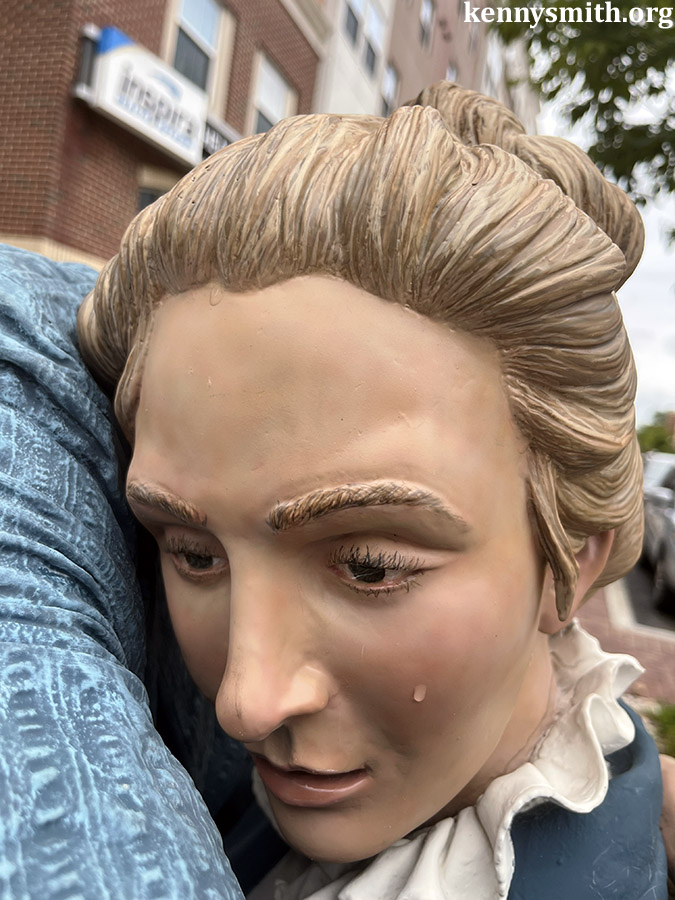
It looks like an intimate moment, right? Is it a reunion, or a departure? He’s got his hat and suitcase. He looks like he’s almost ready to scoop her up, perhaps in defiance of physics, but there’s definitely a sense of motion in this presentation. The moment we are given not only looks different from different angles, but it looks like a specific movement underway.

You can stand there all day, but they can’t complete the move. It’s frustrating. It’s wonderful.

We’ll try another angle next time, perhaps more will be revealed to us.

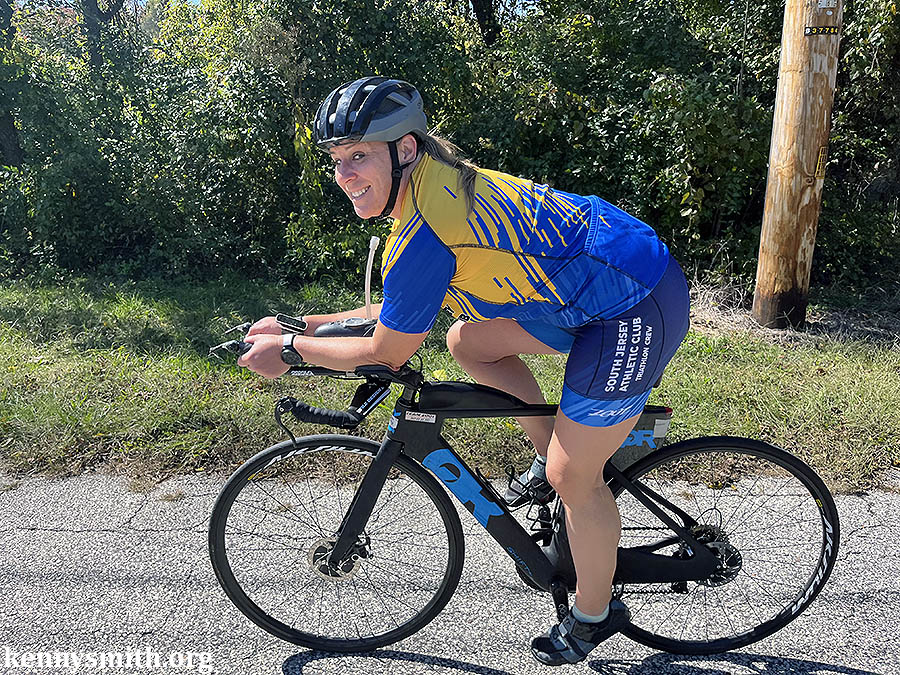
A mystery of my recent bike rides has revealed itself to me. We went out for a ride on Saturday and I sat in my lovely bride’s wheel and watched her calf muscles go to work. It wasn’t too long after this that I got dropped, and did the rest of the ride on my own.

I won’t tell you how far along in the ride that was, or how much I soloed. It might be embarrassing. (But just for me. She’s riding super well, and I’m not. She keeps getting better and I stay about the same.)

On this evening’s ride, I happened upon a run of turkeys. They weren’t there when I came back by, so this is, unfortunately, as good a shot as I can offer. I think I might have scared them off with my huffing. Unless I was puffing at the time.

It’s possible that The Yankee startled them away. She does a delightfully hilarious turkey call and that might have been enough to send them into the treeline and out of sight. I passed them, first, however, so I don’t know. Which is to say I was out front. I had a decent ride and she was casually letting me dangle varying distances in front of her. But here’s more proof. She took this, when I was ahead and she was chasing.

That lasted about an hour. Then she came alongside me, right near the end. But I won.

Mostly because she didn’t realize we were racing.

When I win, we are racing. When she wins, it is an exhibition.

I finished up Rick Atkinson’s Fate of the Day, on Sunday. This is the second installment in his Revolutionary War trilogy, and I need him to finish the final volume in the next week or two. It’s a wonderful book, as you’d expect from a talented and accomplished writer such as he. I highly recommend it.

Ebenezer Stanton would become a lieutenant in the army. He was a paymaster here. Somehow, he moved to the navy, and so he takes the captain honorific. He was a fourth generation Connecticutonian. His great-great-grandfather founded the little town of Stonington. During the war he married. They would have six children. He took command of a privateer of the Connecticut Navy, but I can’t find anything on that particular vessel at the moment.

He stayed on the sea after the war, sailing from New London, Connecticut to ports on the Mediterranean Sea. He died at 53, in 1811, and would be survived by his widow by 39 years. One of their sons died at sea. His namesake died in Italy just a few months after he did. They also had two daughters, who lived into adulthood and married. One passed away in Connecticut, the other in Cuba. Their oldest child, Nathan, also lived the longest. He died at 57, in Stonington. He had a niece, who he probably knew, who lived until 1893. It all seems so simultaneously close at hand and far away.

This second book ends with the sacking of Charleston, the British general, Clinton, then sailing back to New York after the 30-page expedition in South Carolina. The Gordon Riots in London, which are the biggest disturbances there until WW2, is in the epilogue, but then so to is the return of Lafayette, from France, promising his guns and ships.

There are 200 pages of notes and citations.

When I finished it, I clapped the book shut, put it on my chest, crossed my arms and smiled for a bit.

Hurry up, Atkinson.

I started reading Adin Dobkin’s Sprinting Through No Man’s Land. This is about the first Tour de France after the conclusion of World War I. When Armistice came race designer, and editor of L’Auto Henri Desgrange announced Le Tour would return the next summer. They had to wait for the shooting to stop to go see the roads, the bombed out villages, and design the course. The route was beyond demanding.

As Dobkin writes, a few stages in, “More than 400 kilometers stood in front of them that day. After that, the cyclists would confront the longest stage the Tour had seen. Then, the alpine climbs would begin.”

I’m five chapters and 101 pages in and there’s something missing. I think it needs more of all of the things I’m interested in. Dobkin gives a real nod to the importance of the still young race, culturally, but you could write a lot more about this.

I somewhat understand how the races work today, and they were certainly different a century ago. This book alone makes that clear, if you didn’t know it already. But it’d be nice to see how all of this came to be, and precisely how this race evolved into such a cultural touchstone for France.

But that’s not Dobkin’s job here. Other people have written that, I’m sure. I’ll get to some of it eventually.

For some reason, and maybe this becomes clearer, there are asides on the war, not just the racer’s experiences. There’s a bit on the American 813th Pioneer regiment which was briefly in France. This, and units like it, deserve more attention than they have received. But how does that figure here? Similarly, there’s a digression into Camp Pontanezen an important American troop depot near Brest. The race went by there, but I don’t know why we did.

A better story would be unpacking Quimperlé. Dobkin tells us they had about 9,000 souls before the Great War, but lost something like four percent of their population. I’d rather learn about the terrible impact there.

Also, Henri Pelissier.

He may or may not be getting outsized coverage here. (I won’t spoil the results of a 112-year-old race.) He’s a real character though. Everyone agreed he was a strong bike racer, but he thought it most of all. And while his peers might have disagreed with his own self-evaluation, they all agreed with each other that he was not the most liked man in the peloton.

He was one of four sons. Three of them became bike racers, one died in the war. His father was a cattleman, but they feuded constantly. And Pelissier also feuded with Desgrange and other race organizers. To be fair, pretty much everyone either loved or loathed Desgrange, and I’m not sure if anyone that participated in his races went into the first group.

In his racing career, Pelissier won 10 stages of the Tour in five different years. He won the overall race in 1923. He was also a national champion, and won most of the large races in France and Italy. It went downhill when he got off the bike in 1927. He wasn’t successful in his later pursuits. His wife killed herself in 1933. He met another woman and they were huile et eau, and violence domestique. He threatened her with a knife. One night, at a dinner party, he lunged at her, and cut her face. She retreated to another room, found the revolver his wife had used — and she shot him several times, killing him.

It seemed a bad match. She got a suspended sentence.

Which is a happy place to wrap this up. It is late, there is work today and tomorrow to plan. We are building football franchises in Org Comm. I’m sure some anecdote will emerge.


07
Sep 26

Happy Labor Day

Just about the perfect day, weather-wise. Too nice to spend any of it typing here, I should think. I spent the day outside, under this sky, reading.

(Click to embiggen.)

More tomorrow.


04
Sep 26

Into your three-day weekend

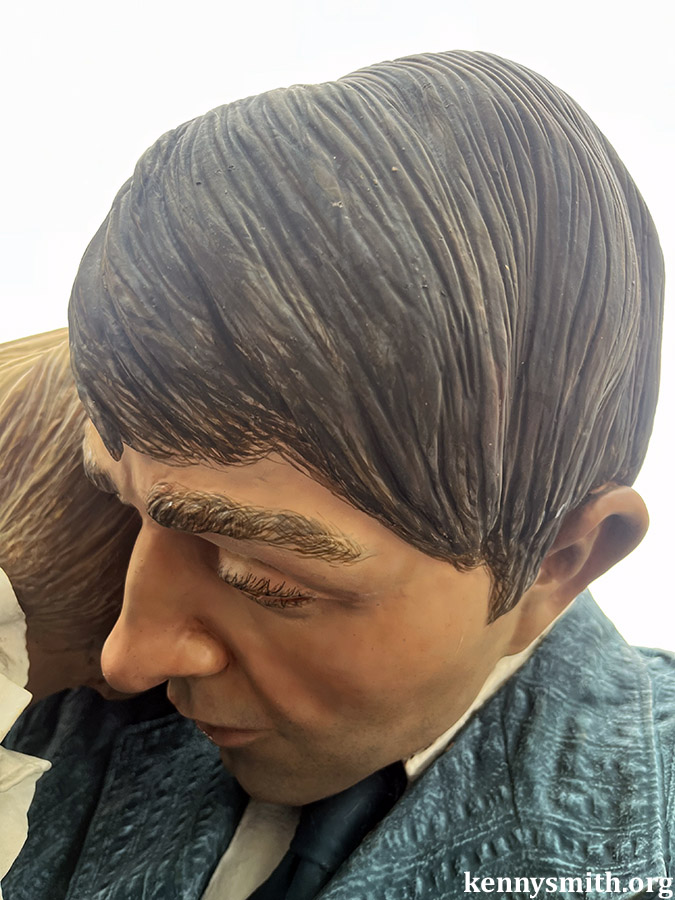
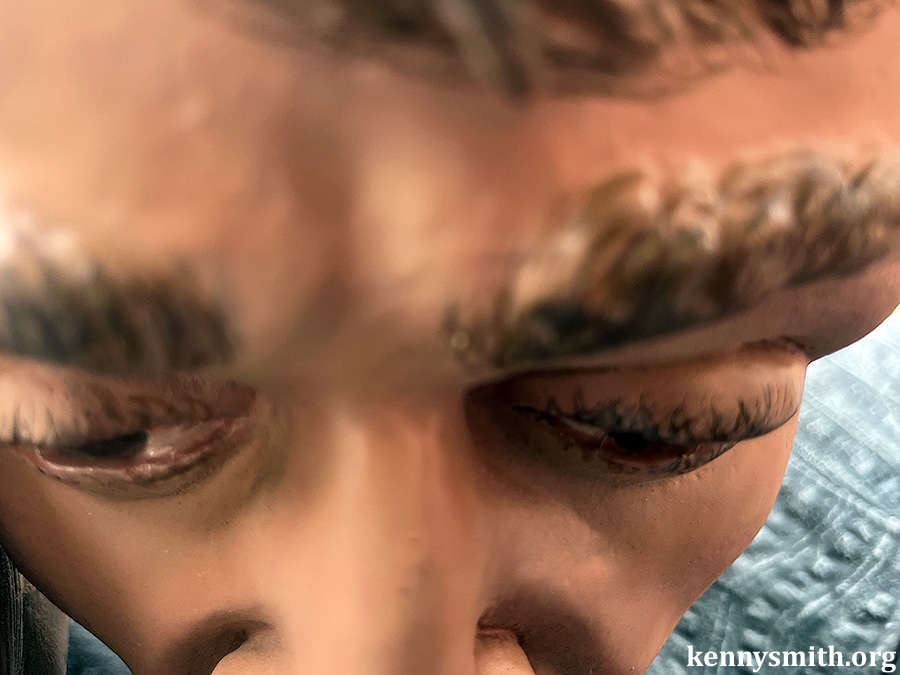
This happened Tuesday, I wrote about it Tuesday, I knew to expect it on Thursday. I put that out of my mind, because that’s easy to do. And when I got there, this gave me pause once again. Here’s the statue that will trip me up every time I walk by it on the way to, and from, class. I’m curious how deep into the semester I will go before some lower part of my brain — my lizard brain, as one of my grad school professors called it — doesn’t override the rest of my mind. Let’s document it from different angles as the semester progresses. Just ahhhh … don’t lock in on her hands.

You might want to pay attention to the textures of the coat here. I’m not sure if there’s a code there or if I’ve already stared at this too much.

Anyway, that’s the view as I walk up the block to the building where my class is held, from the office. Next week I’ll take the 90 degree, as I return from my class to the office. I think we’re going to learn a lot about this art this term.

That class was fine, by the way. We talked about our favorite and least favorite social media platforms. More than just a throat-clearing session, we touched on a few of the whys behind those ideas, and also I got to tease how some of the thises and many of the thats will be things we peer into as the semester progresses.

Now we have to read a chapter of a four-star book that examines the social implications of the digital tools that surround us. They have to take a quiz. We will discuss the chapter. I have to start the process of setting them up for success.

People do well in that class because it is interesting, it’s topical, and it’s a well designed course. (I didn’t design it.)

I also didn’t design the HVAC in that building. Floors one, two, and three, I was told, are nice and cool year round. The fourth floor of this incredibly modern building is a spa. Guess which floor my class is on. I talked with one of my colleagues that works in the building, a fan running at her door. The people that control such things know this is an issue she said, and it’s the usual condition.

Good thing sports coats are wicking? I guess? Can I wear Dri-FIT to class? I’d like to not be embarrassing, but I’d also like to be comfortable, sitting still, and sweating, for 75 minutes.

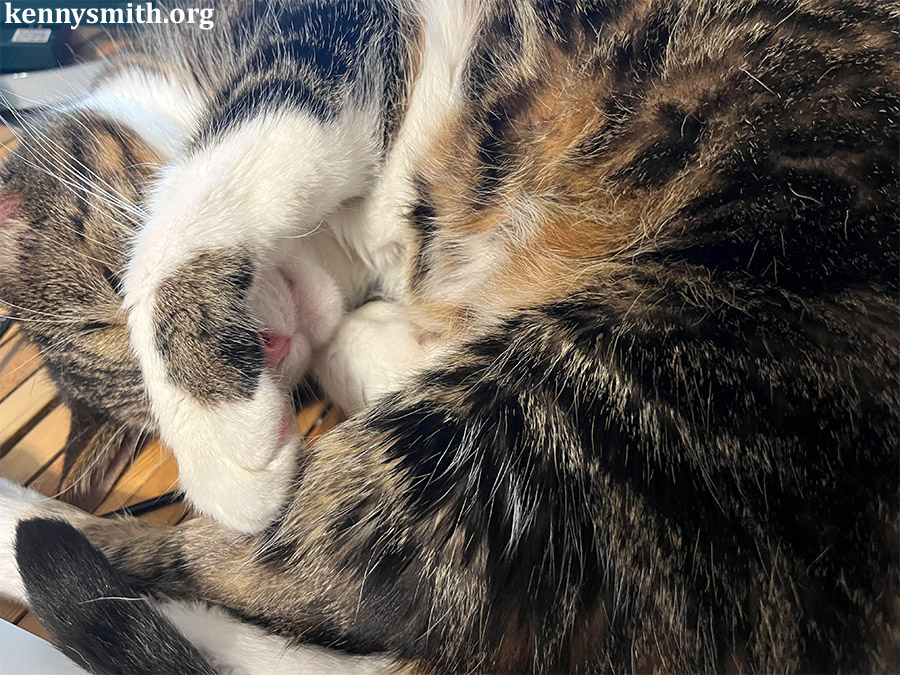
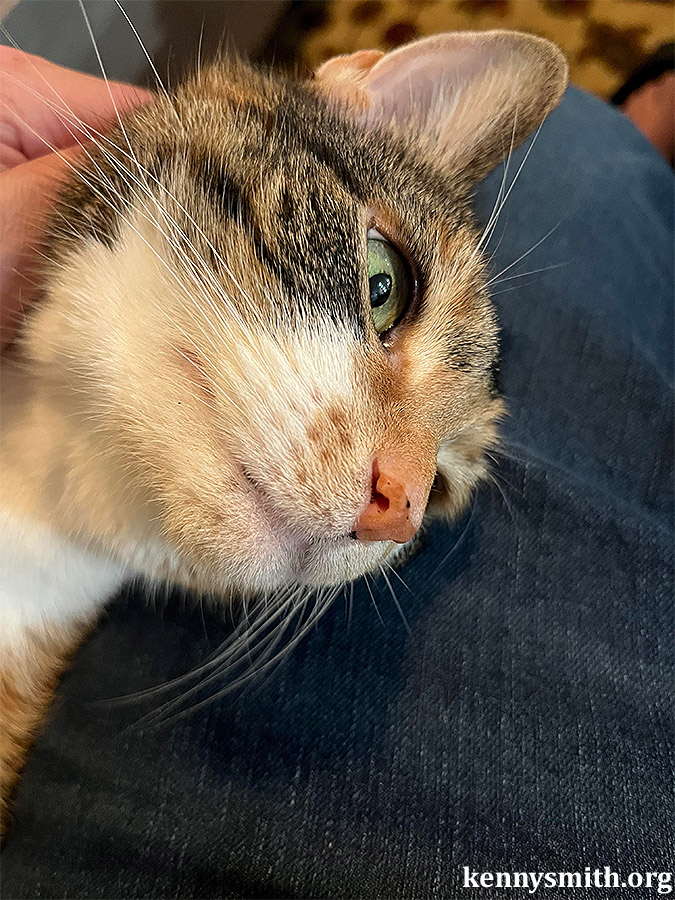
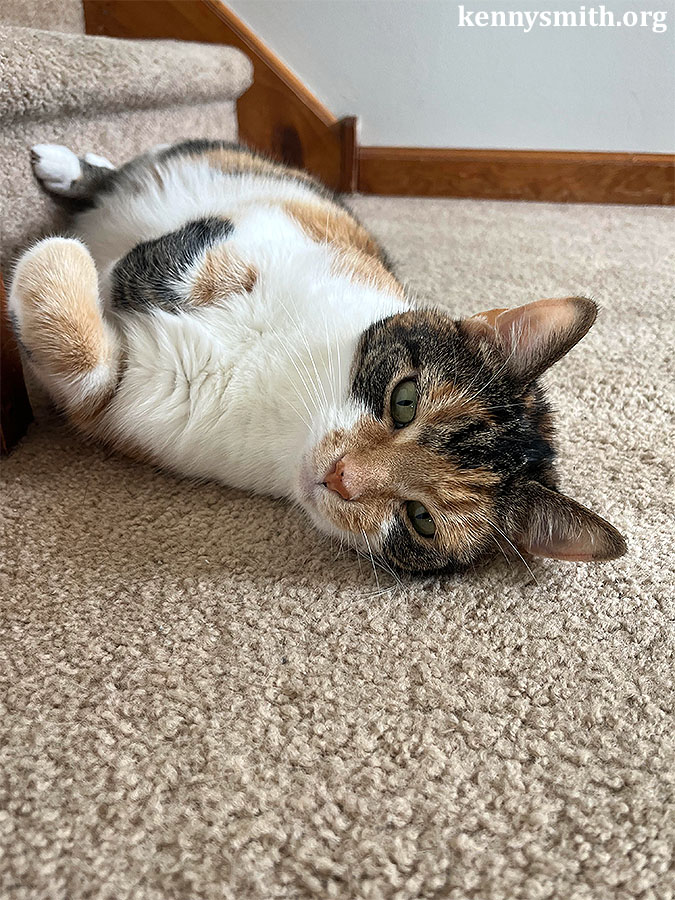
Speaking of comfort. Phoebe finds that the sofa isn’t comfortable enough for a nap, but a pillow on the sofa? That will do nicely.

And so, as we wrap up the week with our regular check-in with the kitties, you can see that she is doing just fine. I’ve said this for a long time, and she always proves me right: no one relaxes harder than Phoebe.

We’ve been watching the now-Tadej Pogacar-less Vuelta, the three-week grand tour bike race of Spain. The other night, Poseidon was inspired to work on his aero position.

He’s got good form, but he needs to get those ears down. If he can do that, he might have a shot in the time trial.

We’ve also been working on his new promo material. Here you can see Poe’s latest headshot.

Phoebe is on the floor, next to me, as I put this together, fussing that there should be more of her in this post and less of her brother. The cats are doing just fine.


03
Sep 26

The 1926 Glomerata, part two

We return to the dusty old pages of old yearbooks. This is a quick tour, where we are spending just two weeks on this particular year. The photography is a bit limited, but there are great stories, so we’ll wrap up 1926 in this large batch before moving on to another book next week. Enjoy a few pretty pictures from the Plains. (See part one here.)

These were, as we learned last week, troublesome days on campus. The university president, a man named Spright Dowell, wasn’t viewed as particularly effective. The university was about to celebrate its 70th anniversary, but the buildings needed work, the faculty needed raises, the sports programs were all struggling. and the university needed some actual respect from the state. It’s a persistent tale, particularly in those early years. The students hanged him in effigy.

Curiously, people seemed to like him as an individual, but didn’t seem to think much of his job performance. The newspaper editorials were unsparing, and they took turns at pointing at all of these problems and more. Of course, one of the newspaper bigwigs was on the board of the university. The ties and tendrils were everywhere, as they always are. Dowell knew the score, at least somewhat. He pointed to the athletics issues. He mentioned, the next fall, that perhaps he could have spent some more time being a man of the people. Perhaps he had in mind here his predecessor, who was well liked. Instead, Dowell said, he chose to spend his time focusing on the money problems. Certainly, when he said that, he had a lot of influential people in mind. Weeks after he said it, and before this book was terribly out of date, he would resign from the university. His tenure would end after seven trying years. He became the president of Mercer University the next year, where he’d stay for 15 years. But this isn’t about him. It’s about what’s inside this book, a handsomely produced, 375-page piece of history.

We wrapped up last week with the athletics section of the century-old book. The next few pages showed the “Beauties.” These women don’t always show up in other areas of the annual. In some editions they seem to just be local people. They were selected for this by Florenz Ziegfield Jr., the director of the Ziegfield Follies, which was still a cultural high water mark for the country.

I’ve not yet found the rhyme or reason for how all of that worked, other than Ziegfield liked the photos they sent him. Also, these women can sometimes be difficult to trace if they took their husband’s name in public mentions. If nothing else, we can get a glimpse of the hair and some of the clothing styles of the day.

Nell Thomas, for instance. I believe she was from Montgomery. She might have been the daughter of a prominent appellate judge. (But even there following her digital trail gets fuzzy.)

Bertrice Black was from Birmingham. She would get married in 1927 or thereabouts. Her husband would become an accountant, and served as a captain in the army during WW2. They had one daughter. Bertrice, sometimes, or at least later, it was Beatrice, died in 1977 at age 73.

Eula Martin is a name that feels so incredibly familiar I’ve spent the last few minutes trying to figure out if I’ve ever written about her before. I have not. Clearly, though, she had a thing for flappers and fur. Also this is one of the most soft-focused photos in the book. (I happen to be an expert on fuzzy focus.) She attended Howard College, the modern Samford University. She was a dancer. And this seems to be a photo that became her promotional headshot. Martin, or someone with the same name, was quite active in the social pages of the late 1920s. She came from a family that had lived in the state when it was still a territory. She wrote poetry. Throughout her long life she would join all of the important social and community organizations that a woman of her stature should maintain. She would marry — 99 years ago today — a man that we’ll meet in just a moment. They had a son. She passed away at 90, in 1995.

Martha Porter likewise doesn’t show up elsewhere in the Glom. She was from Tuscumbia, in the northwestern corner of the state. She became a teacher in a little town on the Tennessee River. She got married the next year to a Bama grad. He was a roofer and would eventually become the president of that local firm. He died in 1970, she lived until 1993. She lived in Florida for several decades. They had one daughter, a woman who passed away just a few years ago, who has a lovely obituary.

Elizabeth Chester just looks here like a silent movie starlet. She’s from Atlanta. She’s not otherwise in the Glom. I can’t find anything about her for certain.

And this is Margaret Whittle. She’s from Atlanta. If you know anything about her, pass it on.

Good as it is, the problem with books of this particular vintage is that the casual photos are almost always small. Usually they are of spotty quality. The equipment available to a poor college campus might not have been the best. Or maybe its the photographs. Perhaps my limited digitization. Whoever we blame, and blame me, the few pages of casual campus life all look like this, and if you get cutlines they are usually short on details that help us find out more about the people in them.

You see some fans here, some sort of band thing, a line where students wait patiently in line to register for classes, and two shots of the Wreck Tech parade, which was part of the festivities before the Georgia Tech football game. (It was the final game of the year, in November, in Atlanta. The good guys lost.)

There’s a section called Death, and it’s filled with poems and prose and jokes that probably made sense to the 21-year-olds who were already feeling nostalgic, but most of it is lost to us as personal reference. There’s some fun art in there, filling up the space, though. This took up a full page. Some of it looks like campus, some of it doesn’t seem familiar at all.

We have a rule that we always show the bikes that wind up in the Glom. Apparently that applies to the ones that are drawn, as well.

They look almost as cool as the real thing, anyway.

Here’s another one of those little marginalia doodles that is destined to become some sort of clip art around here.

This is the staff that put together the book. The business manager is Ben Screws Gilmer, of Montgomery, who was a senior studying electrical engineering. He’d worked on the Glom for two years. The blurb by his portrait in the class section recalls him as a gentleman, a conscientious student, and “As to him being a ladies man, we take great pleasure in referring you to Atlanta.”

Perhaps he was legendary.

He went to work at Bell System right after graduation, starting as an installer. Phones, wires, poles, I don’t know, but he did that for a month and then went into the company’s leadership training course. That was a wise choice by the company and him. He found his way into marketing and development, and then into regulatory work. He served in the U.S. Army Air Corps during World War 2, rising to the rank of lieutenant colonel. He returned to Southern Bell, became an assistant vice president and, before long, was running much of the phone company’s business in nine states. He also worked for Northwestern Bell, Pacific Telephone, and, eventually AT&T, where in 1967, he became the president of the company. He also served as either director, chairman of the board, or trustee of more than thirty civic and charitable organizations. The university gave him an honorary doctorate in the 1950s. In 1975, he was inducted into the Alabama Academy of Honor by the state legislature. He is similarly honored in the Alabama Business Hall of Fame and the Alabama Engineering Hall of Fame. His industry peers in Georgia would likewise honor him. All of that started right here. He and his wife had a daughter. When he died, at 98 in 2004, he also had two grandchildren and two great-grandchildren.

The editor was Charles Snook, a senior architecture major from Birmingham. Snook was in all of the leadership organizations on campus, it seems. He was also an ROTC captain. Who knows when he had time to attend class. Later, he served as a commander in the Navy. In his professional life he went to back to the Birmingham suburbs and worked as an architect. Snook was vice president of the local chapter of the American Institute of Architects and worked on at least one of those downtown revitalization projects that are necessary from time to time. I can’t readily find a list of his projects, to confirm it, but the odds are very, very good I know of some of his work, if I’ve not been in the actual buildings he designed — albeit decades later, of course. He had one son, who became a reverend, as did one of his five grandchildren. He died in 1973.

The art editor is William Sandifer, a senior from Mississippi who was also studying architecture. He was another prominent campus leader. Part of his yearbook blurb jokes that he majored in letter writing and minored in sleeping during class hours. And this was one of the men who helped design the Empire State Building, the World’s Fair, and several U.S. embassies. He’d served in the Army Corps of Engineers during the war, mustered out as a colonel, with Manila as his last duty station. In 1947 he and his wife purchased a huge, renowned ranch in Colorado, Greystone. He died in 1986, at 85.

Here’s the campus paper. I’d work there decades later, and didn’t give the first thought to the existence of any of these people, because I was 19 or 20 at the time, just like some of these people. They turned a post-game extra 15 minutes after the game was over using 1920s technology. That’s impressive in any era.

Jasper F. Thompson was another electrical engineering major from Birmingham. “Fritz,” it says here, “is a likeable cuss — always jolly, never worries and has a good word for everyone. The best ‘ain’t’ too good for him.” He worked as an executive with the Red Cross, pretty much running things across the southeast. He’d lived in Georgia for almost two decades, while his brother and his father were judges in Alabama. When he died, of a heart attack, in 1960 he and his wife had two adult children, a daughter and son.

Edward Donald Ball was the managing editor. Apparently he dosed off in classes. He caught on at the old Birmingham Age-Herald after school. He worked around the southeast, and in New York before the war. E.D., as he was known, would become a significant European war correspondent. Back home, he ran the Tennessee bureau of the Associated Press office. He worked for the AP for 31 years. He lost a young son, aged 18, in 1951. In 1959 he became editor of the Nashville Tennessean. He died in Georgia, at 88, in 1992. He was survived by his wife and a daughter.

William Horton was an engineering major from Virginia. He played football for three years, and was the sports editor of the paper. He was also an editor of a specialty engineering publication. They called him “the preacher, the philosopher, and the journalist of the Civil Engineers.” He’s difficult to trace definitively after college, however.

I’m assuming this was just yearbook art, but it also looks like a great poster. Illustrators could make some lovely work given the styles of the day.

Here’s the radio club, which is part of a fascinating little history at Auburn. I’ve written about it several times in a few places over the years. It was the early days of the technology, and these were days of important transitions with the technology on campus. By this point they had a handful of radio telegraph sets, and a radio phone. They could send a signal a good distance at night, but it was especially limited during the daytime. The hand-me-down gear was still serving the farmers who could hear the signal. The university had been a pioneer in the field in 1912 and 1913, but decisions had to be made about the future. And these guys were watching.

In 1925 WMAV would close its doors. This was a part of necessary upgrades. They built a 200-foot transmitter tower just south of campus. There were actually two stations working from campus after that. In February of 1926, probably just before this yearbook was released, WAPI took to the air for the first time. Many decades later, I broadcast on WAPI early in my professional broadcasting career.

One of these 1926 guys, as we learned last week, went to work for the American Telephone and Telegraph Company. He was a natural. Louis Howle was sending messages to stations in California so rapidly they couldn’t decipher his dots and dashes. J.M. Wilder ran the old WMAV when it came back to the students, from Birmingham, in the year prior.

John McCaa had a great live broadcast moment earlier this year.

(O)ne night we had a request for a popular number. Everyone could play it, but no one knew the words . I was selected to sing the words, so 1 propped the music up in a chair where I could read the words while playing. Everything was going fine till, when about half through, a strong breeze came through the windows and blew the music across the room. I just broke out laughing as did the others. The confusion lasted for about five minutes before we got back to playing again. Our mail from that program was more than usual, and of all things, people asked us to repeat that program as they had enjoyed our “skit.”

A few years after this someone conducted a a survey of land-grant schools that had gotten into broadcasting. A lot of them got out — poor financing, poor gear, low power, programming and technical difficulties. Auburn was one of those that stuck with it, though the people working in this area would do it with some miseries. By the end of the decades the second boom period of broadcasting at Auburn was waning. Sports were proving to be the only thing that could keep and captivate listeners. There were also all sorts of problems with frequency hopping. And then came the rise of the networks.

I’m glad they stuck with it. The radio that I knew, which would be all but unrecognizable to all of those men in the photo above, was one important part of my student experience.

All of these will wind up in the Glomerata section (eventually). You can see others, here. Or maybe you’d like to click through to see all the covers. The university hosts their collection here.