
03
Sep 26

The 1926 Glomerata, part two

We return to the dusty old pages of old yearbooks. This is a quick tour, where we are spending just two weeks on this particular year. The photography is a bit limited, but there are great stories, so we’ll wrap up 1926 in this large batch before moving on to another book next week. Enjoy a few pretty pictures from the Plains. (See part one here.)

These were, as we learned last week, troublesome days on campus. The university president, a man named Spright Dowell, wasn’t viewed as particularly effective. The university was about to celebrate its 70th anniversary, but the buildings needed work, the faculty needed raises, the sports programs were all struggling. and the university needed some actual respect from the state. It’s a persistent tale, particularly in those early years. The students hanged him in effigy.

Curiously, people seemed to like him as an individual, but didn’t seem to think much of his job performance. The newspaper editorials were unsparing, and they took turns at pointing at all of these problems and more. Of course, one of the newspaper bigwigs was on the board of the university. The ties and tendrils were everywhere, as they always are. Dowell knew the score, at least somewhat. He pointed to the athletics issues. He mentioned, the next fall, that perhaps he could have spent some more time being a man of the people. Perhaps he had in mind here his predecessor, who was well liked. Instead, Dowell said, he chose to spend his time focusing on the money problems. Certainly, when he said that, he had a lot of influential people in mind. Weeks after he said it, and before this book was terribly out of date, he would resign from the university. His tenure would end after seven trying years. He became the president of Mercer University the next year, where he’d stay for 15 years. But this isn’t about him. It’s about what’s inside this book, a handsomely produced, 375-page piece of history.

We wrapped up last week with the athletics section of the century-old book. The next few pages showed the “Beauties.” These women don’t always show up in other areas of the annual. In some editions they seem to just be local people. They were selected for this by Florenz Ziegfield Jr., the director of the Ziegfield Follies, which was still a cultural high water mark for the country.

I’ve not yet found the rhyme or reason for how all of that worked, other than Ziegfield liked the photos they sent him. Also, these women can sometimes be difficult to trace if they took their husband’s name in public mentions. If nothing else, we can get a glimpse of the hair and some of the clothing styles of the day.

Nell Thomas, for instance. I believe she was from Montgomery. She might have been the daughter of a prominent appellate judge. (But even there following her digital trail gets fuzzy.)

Bertrice Black was from Birmingham. She would get married in 1927 or thereabouts. Her husband would become an accountant, and served as a captain in the army during WW2. They had one daughter. Bertrice, sometimes, or at least later, it was Beatrice, died in 1977 at age 73.

Eula Martin is a name that feels so incredibly familiar I’ve spent the last few minutes trying to figure out if I’ve ever written about her before. I have not. Clearly, though, she had a thing for flappers and fur. Also this is one of the most soft-focused photos in the book. (I happen to be an expert on fuzzy focus.) She attended Howard College, the modern Samford University. She was a dancer. And this seems to be a photo that became her promotional headshot. Martin, or someone with the same name, was quite active in the social pages of the late 1920s. She came from a family that had lived in the state when it was still a territory. She wrote poetry. Throughout her long life she would join all of the important social and community organizations that a woman of her stature should maintain. She would marry — 99 years ago today — a man that we’ll meet in just a moment. They had a son. She passed away at 90, in 1995.

Martha Porter likewise doesn’t show up elsewhere in the Glom. She was from Tuscumbia, in the northwestern corner of the state. She became a teacher in a little town on the Tennessee River. She got married the next year to a Bama grad. He was a roofer and would eventually become the president of that local firm. He died in 1970, she lived until 1993. She lived in Florida for several decades. They had one daughter, a woman who passed away just a few years ago, who has a lovely obituary.

Elizabeth Chester just looks here like a silent movie starlet. She’s from Atlanta. She’s not otherwise in the Glom. I can’t find anything about her for certain.

And this is Margaret Whittle. She’s from Atlanta. If you know anything about her, pass it on.

Good as it is, the problem with books of this particular vintage is that the casual photos are almost always small. Usually they are of spotty quality. The equipment available to a poor college campus might not have been the best. Or maybe its the photographs. Perhaps my limited digitization. Whoever we blame, and blame me, the few pages of casual campus life all look like this, and if you get cutlines they are usually short on details that help us find out more about the people in them.

You see some fans here, some sort of band thing, a line where students wait patiently in line to register for classes, and two shots of the Wreck Tech parade, which was part of the festivities before the Georgia Tech football game. (It was the final game of the year, in November, in Atlanta. The good guys lost.)

There’s a section called Death, and it’s filled with poems and prose and jokes that probably made sense to the 21-year-olds who were already feeling nostalgic, but most of it is lost to us as personal reference. There’s some fun art in there, filling up the space, though. This took up a full page. Some of it looks like campus, some of it doesn’t seem familiar at all.

We have a rule that we always show the bikes that wind up in the Glom. Apparently that applies to the ones that are drawn, as well.

They look almost as cool as the real thing, anyway.

Here’s another one of those little marginalia doodles that is destined to become some sort of clip art around here.

This is the staff that put together the book. The business manager is Ben Screws Gilmer, of Montgomery, who was a senior studying electrical engineering. He’d worked on the Glom for two years. The blurb by his portrait in the class section recalls him as a gentleman, a conscientious student, and “As to him being a ladies man, we take great pleasure in referring you to Atlanta.”

Perhaps he was legendary.

He went to work at Bell System right after graduation, starting as an installer. Phones, wires, poles, I don’t know, but he did that for a month and then went into the company’s leadership training course. That was a wise choice by the company and him. He found his way into marketing and development, and then into regulatory work. He served in the U.S. Army Air Corps during World War 2, rising to the rank of lieutenant colonel. He returned to Southern Bell, became an assistant vice president and, before long, was running much of the phone company’s business in nine states. He also worked for Northwestern Bell, Pacific Telephone, and, eventually AT&T, where in 1967, he became the president of the company. He also served as either director, chairman of the board, or trustee of more than thirty civic and charitable organizations. The university gave him an honorary doctorate in the 1950s. In 1975, he was inducted into the Alabama Academy of Honor by the state legislature. He is similarly honored in the Alabama Business Hall of Fame and the Alabama Engineering Hall of Fame. His industry peers in Georgia would likewise honor him. All of that started right here. He and his wife had a daughter. When he died, at 98 in 2004, he also had two grandchildren and two great-grandchildren.

The editor was Charles Snook, a senior architecture major from Birmingham. Snook was in all of the leadership organizations on campus, it seems. He was also an ROTC captain. Who knows when he had time to attend class. Later, he served as a commander in the Navy. In his professional life he went to back to the Birmingham suburbs and worked as an architect. Snook was vice president of the local chapter of the American Institute of Architects and worked on at least one of those downtown revitalization projects that are necessary from time to time. I can’t readily find a list of his projects, to confirm it, but the odds are very, very good I know of some of his work, if I’ve not been in the actual buildings he designed — albeit decades later, of course. He had one son, who became a reverend, as did one of his five grandchildren. He died in 1973.

The art editor is William Sandifer, a senior from Mississippi who was also studying architecture. He was another prominent campus leader. Part of his yearbook blurb jokes that he majored in letter writing and minored in sleeping during class hours. And this was one of the men who helped design the Empire State Building, the World’s Fair, and several U.S. embassies. He’d served in the Army Corps of Engineers during the war, mustered out as a colonel, with Manila as his last duty station. In 1947 he and his wife purchased a huge, renowned ranch in Colorado, Greystone. He died in 1986, at 85.

Here’s the campus paper. I’d work there decades later, and didn’t give the first thought to the existence of any of these people, because I was 19 or 20 at the time, just like some of these people. They turned a post-game extra 15 minutes after the game was over using 1920s technology. That’s impressive in any era.

Jasper F. Thompson was another electrical engineering major from Birmingham. “Fritz,” it says here, “is a likeable cuss — always jolly, never worries and has a good word for everyone. The best ‘ain’t’ too good for him.” He worked as an executive with the Red Cross, pretty much running things across the southeast. He’d lived in Georgia for almost two decades, while his brother and his father were judges in Alabama. When he died, of a heart attack, in 1960 he and his wife had two adult children, a daughter and son.

Edward Donald Ball was the managing editor. Apparently he dosed off in classes. He caught on at the old Birmingham Age-Herald after school. He worked around the southeast, and in New York before the war. E.D., as he was known, would become a significant European war correspondent. Back home, he ran the Tennessee bureau of the Associated Press office. He worked for the AP for 31 years. He lost a young son, aged 18, in 1951. In 1959 he became editor of the Nashville Tennessean. He died in Georgia, at 88, in 1992. He was survived by his wife and a daughter.

William Horton was an engineering major from Virginia. He played football for three years, and was the sports editor of the paper. He was also an editor of a specialty engineering publication. They called him “the preacher, the philosopher, and the journalist of the Civil Engineers.” He’s difficult to trace definitively after college, however.

I’m assuming this was just yearbook art, but it also looks like a great poster. Illustrators could make some lovely work given the styles of the day.

Here’s the radio club, which is part of a fascinating little history at Auburn. I’ve written about it several times in a few places over the years. It was the early days of the technology, and these were days of important transitions with the technology on campus. By this point they had a handful of radio telegraph sets, and a radio phone. They could send a signal a good distance at night, but it was especially limited during the daytime. The hand-me-down gear was still serving the farmers who could hear the signal. The university had been a pioneer in the field in 1912 and 1913, but decisions had to be made about the future. And these guys were watching.

In 1925 WMAV would close its doors. This was a part of necessary upgrades. They built a 200-foot transmitter tower just south of campus. There were actually two stations working from campus after that. In February of 1926, probably just before this yearbook was released, WAPI took to the air for the first time. Many decades later, I broadcast on WAPI early in my professional broadcasting career.

One of these 1926 guys, as we learned last week, went to work for the American Telephone and Telegraph Company. He was a natural. Louis Howle was sending messages to stations in California so rapidly they couldn’t decipher his dots and dashes. J.M. Wilder ran the old WMAV when it came back to the students, from Birmingham, in the year prior.

John McCaa had a great live broadcast moment earlier this year.

(O)ne night we had a request for a popular number. Everyone could play it, but no one knew the words . I was selected to sing the words, so 1 propped the music up in a chair where I could read the words while playing. Everything was going fine till, when about half through, a strong breeze came through the windows and blew the music across the room. I just broke out laughing as did the others. The confusion lasted for about five minutes before we got back to playing again. Our mail from that program was more than usual, and of all things, people asked us to repeat that program as they had enjoyed our “skit.”

A few years after this someone conducted a a survey of land-grant schools that had gotten into broadcasting. A lot of them got out — poor financing, poor gear, low power, programming and technical difficulties. Auburn was one of those that stuck with it, though the people working in this area would do it with some miseries. By the end of the decades the second boom period of broadcasting at Auburn was waning. Sports were proving to be the only thing that could keep and captivate listeners. There were also all sorts of problems with frequency hopping. And then came the rise of the networks.

I’m glad they stuck with it. The radio that I knew, which would be all but unrecognizable to all of those men in the photo above, was one important part of my student experience.

All of these will wind up in the Glomerata section (eventually). You can see others, here. Or maybe you’d like to click through to see all the covers. The university hosts their collection here.


02
Sep 26

What I didn’t do, and what I did

See what had happened was, I was going to ride my bike. Then I didn’t, because I slept a little bit extra. And then I was going to ride my bike, but I didn’t, because there was reading, and then lunch. And then I was going to ride my bike, but I had a nice conversation. And then I was going to ride my bike, but the rain came down in great amounts once again.

So I did not ride my bike. Instead, I spent a few extra minutes getting ready for work.

Then I went to get gas, because that’s a requirement, just like driving right past that big glowing red sign that is our laziest indicator of economic health and foreign adventuring. That number is, as you probably know, too big and going the wrong direction. But, I said, as I saw my next eight meals go into the gas tank, I don’t have to buy gas that often.

Then I went to Lowes. We have a local hardware store. It’s small. The people are helpful. If you need precisely what they have, it’s convenient. We have an even smaller one. The people there are a little standoffish. Odds are they don’t have what you’re after. So, sometimes, you wind up going to a bigger store. My problem here is that the big stores aren’t especially close. They’re near work, but its a few miles off of that, and have you seen gas prices?

I bought a shower curtain rod, because I want to use more of the space in my closet. It’s a small walk-in, which is to say that on one wall there’s a row of clothes hanging. There are two shelves above it. There is also stuff below it. In the back of the closet, which is about three feet long, is where the clothes basket sits. But the ceiling is high, and so in this little space where I can walk in to pick up a shirt, look for a hat or some bit of cycling kit, or drop clothes in the hamper, there’s a lot of wasted space above me. There are also, meanwhile, a bunch of free hangers sitting on one of those two shelves above my clothes. Hangers, of course, just become a tangle and I’m sick of that. I’ve streamlined everything in my closet because nothing matters. I put on whatever is on the right side of the rod. Dress shirts, polos, t-shirts, each sectioned off, each waiting their turn. When the clothes get cleaned and put away, they go on the left side of their section, wait their turn, and move forward. I have done all of this to minimize my time standing in that small space. Now, the time I spend there is in dealing with those empty hangars. My genius solution was to get a high-tension rod, and put everything at about eight-feet. So I had to go to a store.

Then I had to go to campus. This evening we had the first meeting of the organizational communication in sports media class. It’s org comm in a sports context. On its own, org comm is important, but not always interesting as classroom material. This way, because of the sports angle, I can bring in whatever the controversy of the moment is and we can talk about things like imaging, branding, crisis management, internal and external comms, and so on. I like the class. I would. This is the second time I’ve taught it. Last year it was a twice-a-week experience. This time it is once a week.

My goal is to figure out which model is going to be the way we do it in the future, and then begin to change things up so that, hopefully, students will as find it as rewarding as I do. I want to do that because it is a valuable class, even if they’ve not yet realized that themselves. And, if they haven’t, they explain it to me before we’re done. We’re all here to learn, I say a lot.

Happily, the class was quite engaged on this first day. It’s pretty easy when there’s something to talk about, and there’s always something to talk about in sports. Next week I’ll put them into groups.

Anyway, I took no photographs today, but remembered that as I was waiting for the elevator after class. Here’s the building across the street from the building where my office is, and, of course more weather blowing in.

The drought monitor report comes out tomorrow. Surely we’re out of this dry spell by now.

I was eager to put up the shower curtain rod in the closet. (It’s amazing what you can look forward to.) I got greedy and wanted to hang some shirts on it, too, but the thing will only hold so much weight. It took me four failures to realize that. Eventually, I settled on just the hangers. It isn’t pretty. It’s a closet solution in a closet that no one but me is ever going to see. It doesn’t have to be pretty; it only needs to be effective. I’ll let you know. You’ve come along this far, you deserve that at least.

Tomorrow, we return to 1926.


01
Sep 26

First day of classes

Oh it was hot today. The shade was a good four or five degrees cooler, and I was grateful for the shade. There’s a reason people move more slowly where I’m from, and this is that reason. In the old days, before forced air, a person would perish in the real heat. And sometimes they’d do that before they burst into flames. It’s true. You don’t read about it in books all that often, because the books would ignite too. Also, they ban some books there now, which is, we can all agree, just about the most offensive and dumbest performative thing you can do to a collection of ideas. Though the act of doing so does seem to create a lot of curiosity about the ideas contained therein. An inquisitive and rebellious human nature has that going for it.

There’s no reason at all I’m on that subject. It’s really hot here today. It was hot tonight. And humid. It was humid like home. And there were insects everywhere. But we’ll get to that.

Well, class. I have one class on Tuesday. This is Digital Media Processes, and its about the structure and concepts behind our social and digital media. And if that sounds fun, it is! But more is watching me stumble my way through trying to find an easy way to discuss what it means to discuss the conceptual nature of things without getting ahead of myself, which is precisely what I did today. Hey, it was my first day, too.

This was my 19th first day. One day, I’m going to be good at it. Maybe on the 20th first day.

This class was supposed to be in the same building where my office is, but it got moved for logistical reasons and so now I must walk some 450 feet feet and around a corner, to another building. There on the corner is a fiberglass statue. It is a statue of a man and woman in a deep hug and perhaps a passionate kiss, depending on where you are standing. And I’m wondering how many times I’ll walk by it before I think something like, “Awwww, that’s nice,” or “Get a room you guys!” Twice as I walked by it today, I had that sort of reaction to the statue. Let us chart, this semester, how long it takes for something to sink into both sides of my brain.

The class is on the fourth floor of this building, which is where they put all the great classes. All of the professors wind up in the hot box eventually, according to the campus tradition I just made up. They don’t, apparently, put air conditioning in that class. I was sitting at the desk in the front of the room sweating, and it wasn’t nerves. My jacket may have been too heavy for this early in the term. Every jacket is.

Anyway, we did Syllabus and Expectation Day. I talked about what the class was. You’re threading a needle there, I think. I need them to come back. I need them to think this is interesting or useful for them. I don’t want to overwhelm them on the first day. I also need to tell the story of the class and introduce myself and get them talking just a little bit, because they’re going to be doing that a lot this term. And I need to show them the course and a slide deck and I have 75 minutes to do all this.

Here’s my bet, I’ll get back in the groove of laying out and delivering a 75 minute class before I figure out that statue is a statue. Time my brain understands — despite how often I am late in arriving at places. I can still talk 60 seconds without a clock and wrap it up on the post, because of my time in broadcasting, and I haven’t been on the air since the Bush administration. Seventy-five minutes I’ll get adjusted to. My other class, which runs two hours and 45 minutes, I’ll get adjusted to. Can I manage both in one semester? Is that a statue, or are those real people, moving slowly? Very. Very. Slowly.

We traveled from our campus to another campus to see my god-niece-in-law (just go with it) play in her first university field hockey game. I’ve known this little girl her whole life and now we’re watching this young woman, on day two of being a college student, start for her field hockey team as a true freshman.

She’s playing as a forward. She’s been working hard and I’m sure she’ll continue to work hard. The game didn’t go their way this evening. There were two lightning delays. And then the bugs descended. Have you ever been to an event at night where that really fine mist plays on you? The sort where you can’t really see it, but you can feel it and it is so obviously there? And then you look up into the lights and you can see all of that rain dancing and reflecting the light? This was like that, only with insects. More insects than you need to see at one place. The team we were there to see were the visitors and the home team needs to invest in some bats. If they did, those bats would live well.

At one point, the insects were just falling on us. Not flying into us. Falling on us. We joked that despite the two lightning delays, and the continued lightning that the officials ignored in the second half, that they would only call the game if two more almost-plague-like events occurred.

The home team, who no one likes very much won the game. The Knights, who we were cheering on, will fight on again another day. Lane played 52 minutes in probably the most humid conditions any of those young women have ever experienced. It felt like home, honestly. We — her parents were there, as where her grandparents and her aunt and some of her cousins — were sweating just sitting, dodging insects, and cheering on the Knights. Field hockey players do a lot of running.

I have seen enough to see how she is progressing at the craft. When she’s had a few more games in hand I’ll be interested to hear her opinion on how this game is different than the high school version. I noticed a bit of that here, in this one example, and this sport is inscrutable to me. (I stood behind the goal of one of her last high school games and, to me, a soccer goalie, I could see the game a lot better and understand it a bit more, but there’s always a lot to learn.)

Started her first game! She is that rare young person that can peer into the long term. I suspect she’s going to soon come to realize that if she keeps working hard, even better things are going to come her way. Sometimes the ball lands at your feet. She’ll be ready to put it in the cage.

Finally, since it is the first day of the month, I did all of the regular first-day-of-the-month things. I cleaned my desktop. I cleaned the downloads. I emptied the computer’s trash bin. I updated my boilerplates. I updated the spreadsheet where I keep site stats. (Doesn’t everyone do that?) Last month had the most visits in the 22-year history of the site. More than a quarter of a million! I don’t know why you’re all here, I’m grateful for every one of you that isn’t a bot. I’m glad you came back. I hope you’ll do it again.

Also, I updated the art on the front page of the site. This is another 10-photo collage from South Africa, at the Cape of Good Hope. Here’s the theme, but then go look. This will be here when you come back.

Those images will stay up for a month. I’ll update them again for October. Let’s all have a great time until then, shall we?

More tomorrow, including the second first day of classes.


31
Aug 26

The first last day of the summer

It was a calm weekend around here. There were two big highlights. Someone ordered a pickup meal from Longhorn Steakhouse in Florida and used my email as the space filler in Darden Restaurants’ data mining operation. I made fun of their meal. Why do you order seafood, in Fort Lauderdale, from a steakhouse?

And why do you order it for curbside pickup? Do you like lukewarm fish? And chowder? In August? It was 80-something degrees in Fort Lauderdale this weekend. Did you need to warmup? With a shrimp lobster chowder?

How does strawberry lemonade even figure into this? I’m no purist about lemonade flavors, or so I thought, but the more I thought about all of the bad flavors in this styrofoam box and paper bowl … lemonade should be lemonade flavored. Otherwise you’re just telling me about a lifetime of taste bud punishment you’ve inflicted on yourself.

All of this, somehow, costs 41 bucks. But not me. It wasn’t my meal. I did get a survey, and don’t you know I filled that out. I made several pointed comments about Longhorn, and their curbs. But not their service. No need to cause problems for the people working there.

And don’t you know? It worked.

I got a coupon for a free appetizer. There isn’t a Longhorn within less than a half-hour from here, so who needs an appetizer?

The other thing that happened was that my lovely bride did her first time trial this weekend. Just you and your bike against the clock. At the end she found herself on the podium. Third place is great! And enough to send her back again for more.

Otherwise, this weekend was the deep breath in before the semester begins. Classes start on Tuesday. At some point on Sunday I stopped stressing about it. It’s weird. I do more work throughout the term, of course, but I’ve spent a lot of time working on stuff and trying to layout materials and anticipate problems — and then throwing some of that work away and starting over because of, sigh, reasons — throughout August. That whole time has been worry, one stress, one series of second guesses after another. I figured that would all go away after a class or two, or a a few weeks. It usually does. But, last evening, it just disappeared. The classes will be the classes and they’ll be useful and we’ll do fine.

It’s let me do other things. I cleaned one corner of my home office this weekend. And I did a lot in the on-campus office. The Yankee and I have been sharing an office for the last two years, but she’s being moved to a different building, and we moved her this weekend. I’m keeping the old office, so we packed her up Saturday. I brought in a big box of books of my own, which have been sitting in storage for the last three years. I rearranged the desk and generally lamented losing my roomie. What, we’re just supposed to see each other at home? That’s hardly enough.

We had a nice reading date this weekend, and so I point once again to Rick Atkinson’s Fate of the Day, the second installment in his Revolutionary War trilogy. I’m in that bittersweet part of any book you enjoy. You want to plow through it. You want it to last forever. This is an excellent read. Highly recommended.

But I have once again had it confirmed for me that I wouldn’t want to be an 18th century sailor. I’ve been sure of that for a long time, but that impression is confirmed.

There was a bit in here about some French sailors who had been kept on their vessels for more than a year, the details of which were inhumane. But that’s war, and that was navy life, and they didn’t have the comparative advantages of the USS Abraham Lincoln, the sailors of which, by all credible reports, have been on a nightmare service cruise.

If you have the opportunity to have three different people come out to do work on your home in one day, definitely don’t do that. We did that today. It took up the whole day, about six or seven hours, but it was productive. First, we had a guy come out to give us a quote on chimney repairs. There are a few light problems outside and, distressingly, we had some water get inside during last Thursday’s monsoon. That first guy glanced at the chimney from the ground, said we needed a new crown, that his shop would make a customized job. We talked about the stucco. He came inside to look inside the fireplace, and found some problems. He quoted us a price off the top of his head and asked for a 50 percent down payment. We asked him to put his quote on a piece of paper and sent him on his way.

We had an electrician come out, his second time here. Nice fellow. This is the end of a saga that has stretched from April to now, and involved four different companies. He stayed and worked for a long time, trying to figure out the intricacies of this, and the idiosyncratic wiring that had been done to that. Finally, finally the poor guy got things the way they should be. (One of those companies that had been … let’s say involved … won’t be getting a lot of calls from us in the future. They’ll get a letter. I’m pretty close to naming names.)

As he wrapped up his work a second chimney guy came. He deployed a drone so he could actually see what was going on up top.

The previous guy just glanced up that way. We talked about the problems and the options. He had a sneaking suspicion that he could fix that leak straight away, so I trimmed the hydrangea for easier access while he sealed up the flashing. That paired nicely with the spot weeding I found myself doing while chatting with the electrician earlier in the day. Then he, the chimney guy, did some sealing of the places where the lower levels of the chimney touches the house.

He came in with photos, and showed us the before shot of a big hole in the stucco, and someone’s slapdash silicone solution. He said he figured it’d been there for about 10 years. As ever, we muttered the previous owners’ name.

So maybe the leak is fixed. As our guy said, we can’t interrogate the water. If it comes back inside in the next huge storm, though, I’m certainly going to try.

Anyway, that was the weekend and Monday. Somehow I got done, today, all of the things I needed to do — emailing this class and that class, changing some settings on Canvas, doing a little roster prep — but none of the other things I also wanted to do. And that’s OK. They’ll be there for another day. Just not tomorrow. Classes start tomorrow!


28
Aug 26

The platonic ideal of Fridays

We had rain yesterday. We also had a tornado warning, and while my lovely bride grabbed one of the cats and took shelter in the basement, I looked for the other cat. I kept an eye on the radar, an eye on the windows and a third eye looking for the cat, which explains why I couldn’t find her. She came out promptly when the worst of it passed. And the worst of it was atmospheric rotation. And a lot of rain. The three nearest weather stations recorded totals of 4.49, 5.31, and 7.11 inches. Whatever amount we had it was enough to show you where water can come in. And so Monday we’ll have some people out for quotes on how to keep the rain outside, rather than inside. (We have a slight chimney problem. We also have a slight backwash problem in the basement. Having fixed one of those already I know that one will be easier to correct.)

I watched a garbage can float down the road. Someone up the hill hadn’t retrieved theirs for the day and so the thing, lid open, just drifted down the hill on the water. It lost its balance right near the bottom, and fell onto its side in the road. By the time I went to the window to look at it again it was deep into the neighbors’ driveway.

Someone’s going to miss that in a few days.

I had an abstract due today. OK, it is was due Monday, but we’re in that time of year where you are still trying to be ahead of things. So I wrote a 300 word abstract. This takes more time than you’d imagine, but isn’t overly difficult. The problem, as ever, is anticipating what your audience needs and wants, and figuring out where they can make an inferential leap. If your finished paper is 8,000 words and you have to sum it up and tease it in 300, you’re necessarily leaving some things out. It takes a few drafts, is all. And that takes a little time.

Also, there were emails to navigate. Next week email navigation will turn into email negotiation. Then there’s plea bargaining, desperation, and ‘Won’t you please just leave me alone?’ But, if you stay on top of it, you can avoid that for the most part. I stay on top of it by treating my inbox like a To Do list. If I don’t want to To Do it right now it just To Sits There. Or, sometimes, if I don’t want to To Do it I put a particular email in a To Folder, where it will no doubt sit long past its usefulness or my recollection.

I send more emails to my inbox than anyone else does. It’s littered with links to something that might be useful in this class or that class. My recent innovation has been to sort them all into folders for a given class. Now, when I need a new AI example, or an anecdote about, say, stadium operations, I just have to go into that folder. The problem is my innovation isn’t innovative enough to let me sort the emails in the folder accordingly. There they sit, chronologically, waiting for me to sift through them, often trying to guess the subject matter by URL. Perhaps next summer’s innovation will be organized email folders.

Should I start a list of next summer’s projects already? Should I even have a list of summer projects?

Anyway, there is a lot to do. Now, not just next summer. I did a little of it today. My classes are prepared for next week, I think. (One more pass on Monday, the hustle begins on Tuesday. The hustle actually begins Monday. I have to write my opening note to the online class. I have to print out rosters. I have to make sure everything is squared away for the week. I have to settle into the new weekly schedule I’ve sketched out. Basically, Monday I’ll be an entirely different person.)

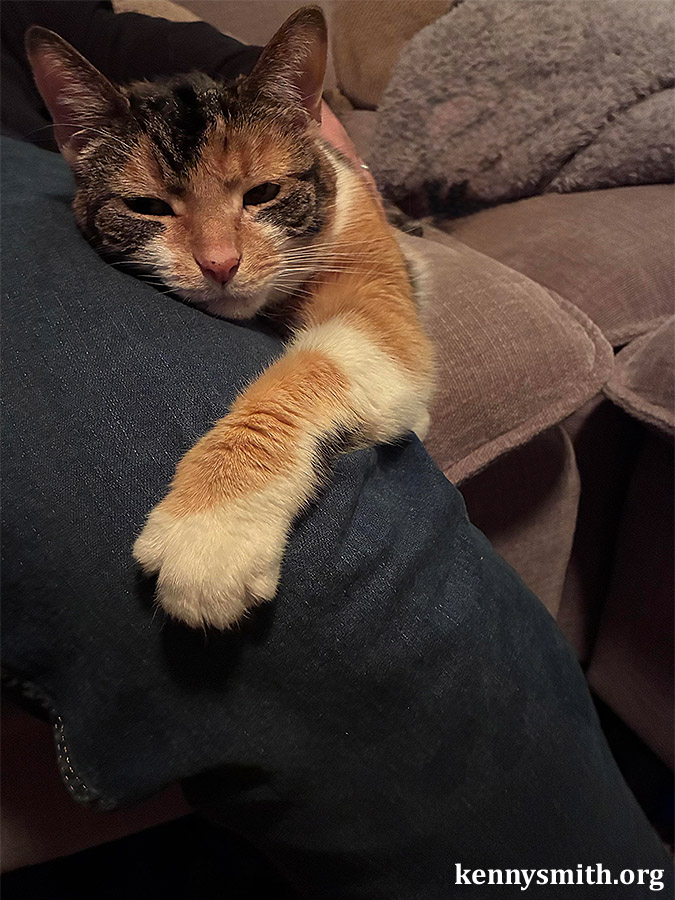
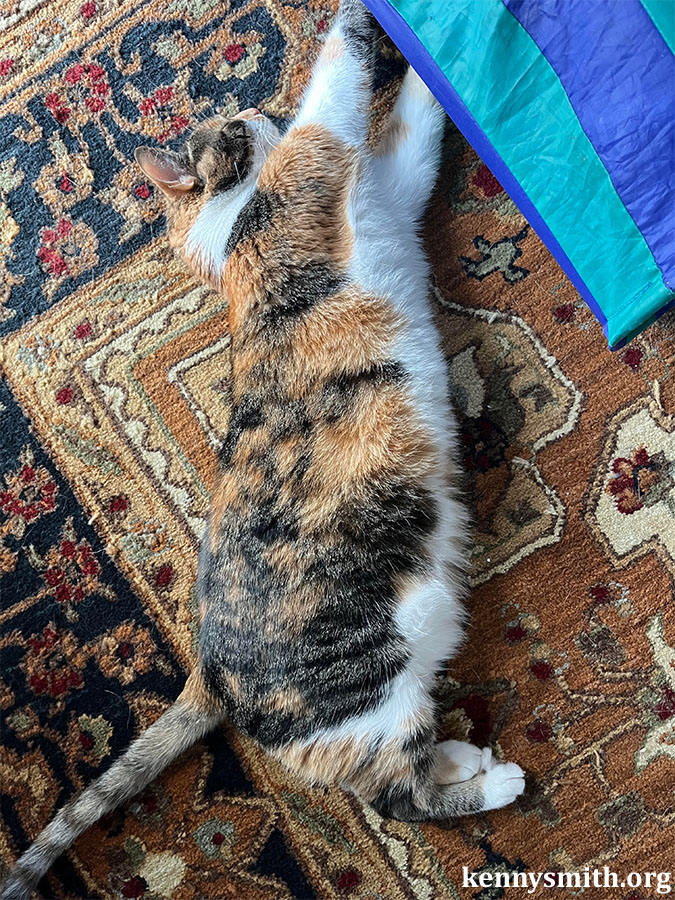
Try explaining this to the cats, who just want their weekly feature — the site’s most popular feature — and also pets, and treats. Phoebe has an idea about those treats.

And here she is, in the new tunnel, thinking tunnel thoughts, I’m sure. We have lots of places where the purpose seems to be I hide here but it is never clear on what we’re hiding from. I’m sure it is instinct, and who are any of us to argue with instinct.

Just look at how handsome this face is. If Poseidon put as much effort into not being a jerk as he can put into being charming … well, we wouldn’t think he has personality issues.

He can be very sweet. Very demonstratively sweet and peaceful, which makes his random outbursts seem all the more rude. Also, he’s a big fan of this book. I’m not sure if he’s a fan of my reading it, however.

Here he was, laying on it last week. A book on a lap might be a highlight for a cat. Who are any of us to argue with instinct?

Speaking of that book, we return now to Rick Atkinson’s Fate of the Day, the second installment in his Revolutionary War trilogy. It’s excellent. Highly recommended.

There are reasons some of the disquieting stories from the Northwest Territory don’t make it into school books. You couldn’t tell the story of Fort Sackville and think there are any good guys at all in the Revolution. Good grief.

Another one of those stories would be the Sullivan Expedition against four British-allied tribes of the Iroquois Confederacy. Congress told our man George Wahsington to do something about it and he, who had fought indigenous people before, had ideas on how to do this. He also was probably ready to go on the offensive after having spent so much of the war dodging and daring the British. So in the summer of 1979 he sent Gen. John Sullivan on a particularly grim task.

Sullivan started late and perhaps didn’t fulfill his objectives to the utmost, but was nevertheless effective. The Haudenosaunee, allied with the British, had raided some white settlements in upstate New York. A few doen people were killed in one such raid, some 300 are estimated to have died in another, at the Battle of Wyoming Valley, and late in 1778 some 30 people were killed in a horrific manner at Cherry Valley. and this was in retaliation for that. It had become clear that offense was what was needed on the frontier. In all, funds were appropriated, orders were given, men were mustered, Sullivan (eventually) stepped off with about 4,000 men. When it was over some months later, his force had razed some 40 villages, with thousands of people trying to survive as refugees and no crops to feed themselves. The estimates suggest that a few hundred natives were killed during what we would today call combat operations, but perhaps several thousand more would perish from disease or starvation.

And now historians debate the thing. Was it genocide? Some, but not all, have said as much.

There are monuments to the Sullivan expedition, dozens of them along the route Sullivan’s men marched. There was a stamp issued 140 years later. By the bicentennial, in 1979, things had become more subdued. There are also reenactments.

You can read some of these details here. But you should also rush out and get Atkinson’s book. It’s terrific.