Spent the day sweating. I was in my office, and so it was only a low-grade sweat. Nevertheless, the 10 or so feet of elevation difference from the ground floor to the second floor is important in terms of the sun. That extra .2 degrees is a real nudge on the ol’ Endothermic Me Meter. I think we got up to 98 degrees today. I find I could do more of the things I need to do outside if I could get outside. It was a productive time inside, though.
I devoted the day to steps that will bring my online class into a real-world classroom. I have taught nine sections of it online, and feel confident in saying this one works well as an online class. Not all courses do, but that’s OK. The university is leaping into more online spaces. We wanted to put the class about digital media back in the classroom.
All of the material is there. It is a well designed class. (One of my colleagues built this class and she has been very kind and generous of her time and thoughts and resources and I’m just trying to do it well and make the smallest changes necessary from time to time, just for relevance. I like the class, and when I compliment it, I am complimenting her work. She certainly deserves the acknowledgement.) But I have to bring online order into a real world chaos. Or vice versa. This is how that’s going.
I have printed out a general calendar to keep track of the happenings in the course. I started by highlighting the days of the class, marking the beginning of the term, the final, and dates it will meet. I counted the weeks. I printed another calendar, one for last spring, so I could write out the proper sequence of events. This rough draft calendar helps to visualize all of the moving parts. I did this because it occurred to me, just last night, how much of the class will shake out in the classroom. I’ll take elements from the online version that would feel vestigial in a classroom and turn them into big talking points. We also have prepped lectures, reading materials, and several long videos we’ll watch over the semester. The elaborate, messy, and ultimately redundant calendar system helped me bring it all into order today. Now all I have to do in that class is make sure all of the assignment dates on Canvas make sense. (While it is an in-person class we are also encouraged to use Canvas.) I have to consider the finalized version of the module setup in Canvas. And I have to update the lectures. That’s all I have to do.
I also made a spreadsheet for the lectures, so that I might keep track of my progress with them over the course of the term. I prepped up the first lecture today, too. Fourteen more weeks of that to go.
For my other classes, I have to finish polishing one class. I made a To Do list today and that class only has three items on the list. My final class has one item. It says: Everything.
So I am caught up on everything except work, which is where I am behind.
In the evening, I went outside, just to cool down. It helped.

Let me tell you what I did last night. We watched Sunday’s stage of the Tour de France Femmes, completing the nine-day event. No surprises there, but some nice racing and the strongest rider won. My lovely bride announced she was going upstairs, which meant it was time for me to do the dishes. We had spaghetti, which was tasty, and I had a frying pan, the great big pot, and various complementary things to clean. I cleaned them with varying degrees of success. I stepped outside to retrieve the garbage can which, having fulfilled its weekly chore, deserved a happy return to the normal resting place.
Then I pulled out one of those new tape measures I bought this weekend. You have to put a little thought into what the first task will be. A stereo needs a great first song, the first movie you call up needs to be worthwhile, and tools need a meaningful first effort. And so I measured the parts of a fly rod that my father-in-law left with us on his recent visit. And, now, every time I pull out that tape measure I’ll think of that.
And probably also this. That’s a silly thing. Tape measures don’t need nostalgic firsts.
Anyway, he left this rod here and it needed to be safely stored and tonight was the night I was determined to find which bin in the basement had all of my old poster tubes. It took some doing, but I did. And wouldn’t you know it? Each one was about two inches too short.
I figured I would make do. Brought them upstairs, set about making do and found he’d also left the actual tube in which fly rods are stored. Excuse me, the fly rod carrier. And give fly fishers this: they have a strong accessory game. Inside the tub was a little cloth roll that held the actual parts of the rod. Once filled, you slide that into the tube, then put on the classy aluminum cap. The carrier is a rich dark green and the cap looks bronze and the whole thing looks like it should be in The Study.
I left this one in our library.
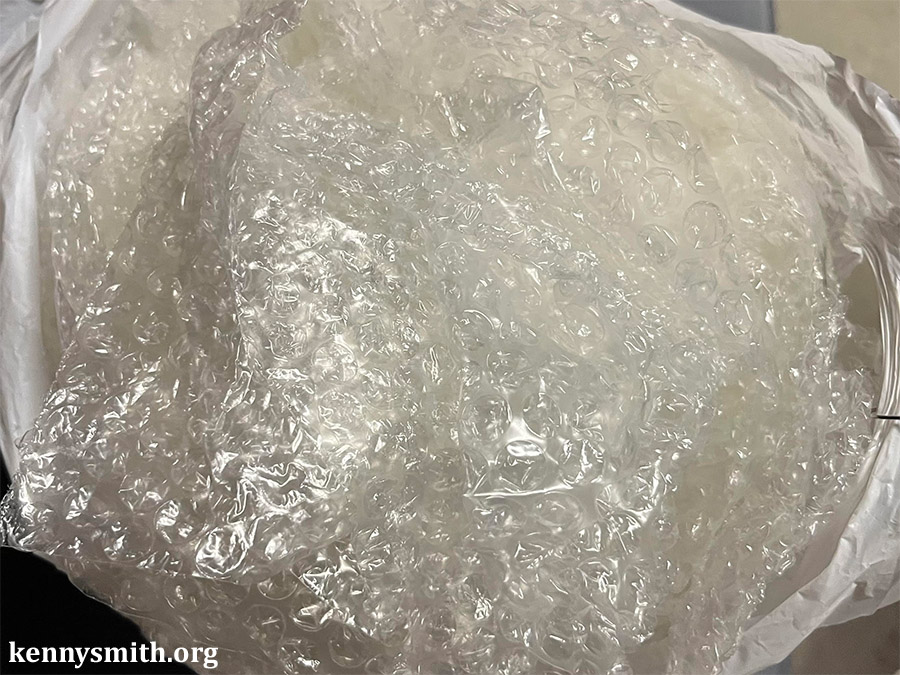
Some magic happened in the basement. I discovered a computer monitor I’d forgotten I had. (Haven’t we all been there? Forgetting high end computer equipment for years at a time? I know I have. How many monitors do I have? If I knew that I wouldn’t be rediscovering them, now, would I? Also, three, if you don’t count the laptop monitor.) I can do something with this, I thought. And I’ll only need to find an HDMI cable. Wouldn’t you know it, right there, in that same bin, there was an HDMI cable. These things could have stayed there, but they are meant to be used, and so they would come upstairs. But that was only the beginning! I found a few empty storage bins, and now I have started a stack of empty storage bins. And this is the beginning of reorganizing that corner of the basement. One of those empty bins just had bubble wrap in it from the last move. Couldn’t throw that away, so it stayed there. But now I wanted an empty bin. I also wanted the bubble wrap, so I set about looking for somewhere to put it and, wouldn’t you know it, at the center of the wads of bubble wrap was a plastic bag. So I laid out the bubble wrap. Then I flattened the bubble wrap.
I did not iron the bubble wrap. That’d be ridiculous. Also, it would melt.
Wouldn’t it?
Hang on.
Yeah, bubble wrap melts under the iron. Don’t do that.
So I smoothed it out with my hands, and then I folded it over. Then I stuffed the smoothed out, folded over bubble wrap into that bag and put the bag in a cabinet, where it will sit until we need to wrap something, or someone else needs bubble wrap, or I think of a better use for that cabinet.
This is momentum. Because before and after the bubble wrap diversion I found the three empty bins, I was able to re-sort a few things on shelves and I’ll remember none of this the next time the mood strikes, in four months.
Also, I changed the air filter.
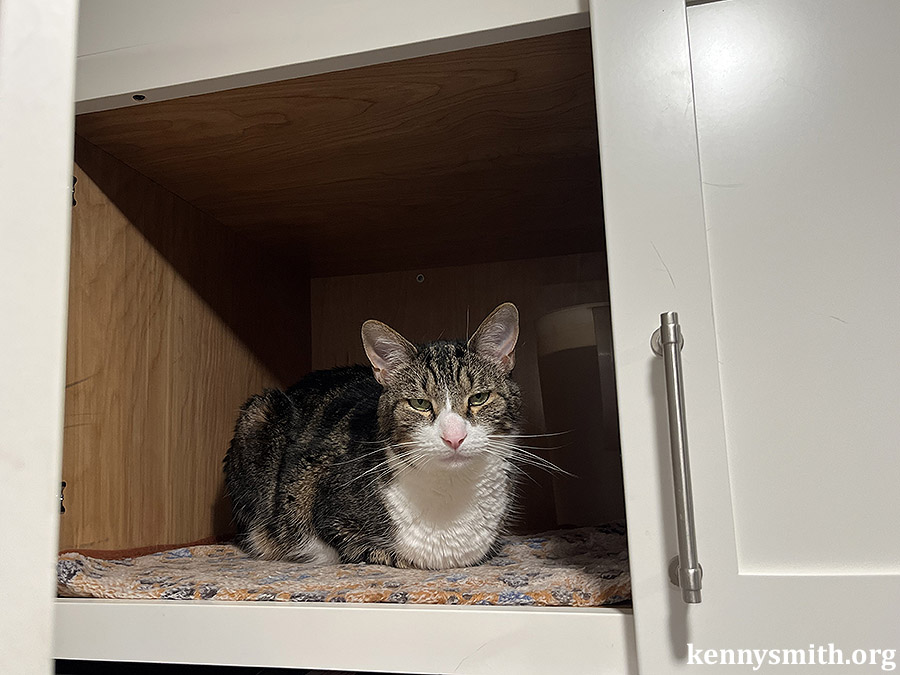
Back upstairs, I cleaned the rando cabinet. Our refrigerator sits inside the wall, basically, and there are two cabinets above the fridge — one of them is famously for Poseidon) — and then there’s a vertical cabinet that holds a lot of cookbooks, but may soon get re-purposed. And below that there’s the cabinet that is the junk drawer of cabinets. It holds our flashlights, 1/64ths of the North American supply of batteries, some tools, some cat treats, and so on. It is the so on that’s the problem. I want one of those new tape measures to stay in that cabinet, with those tools. These are the basics. Two screwdriver sets, a cheaper hammer, some stuff that came with furniture, etc. They live there so we don’t have to fumble about the garage for a small indoors project. And so you can see where all of this is going. Everything is getting reorganized. Well, it is one day. Last night a handful of things that had landed in there for no reason got thrown away. I prioritized the cabinet based on assumed frequency of need. Most important things going on the top shelf and descending from there. It was not done to the degree of my recent linen closet re-organization, but I was able to find three percent more shelf space, and the tape measure or the cat snacks won’t fall out the next time we open the door.
And, thus, I am caught up on everything except work, which is where I am behind. But I have a growing awareness of that behindedness, and also some time to remedy the situation. Not much, so I must step into the task with some alacrity, but time.
I have all of the material in place for two of my three classes. I’ll probably need to add a bit more to the third class. I also need to sort some things out. That scheduling is important and busy work and, experience has shown me, one prone to overthinking. Fortunately, I never do anything of the sort. But I might start! I might step into overthinking with some alacrity.
That’s how I usually do it. The overthinking, I mean.
I also find myself in the healthy activity of dreaming about things I’d like to do. Things I want to do when the weather breaks. When there’s less to do. When I’m not busy. When I have six days in a row of not doing other things when it isn’t almost 100 degrees. But there will always be obligations and obstacles. I am thinking about the things I’ll do after my next travel trip, things I want to do on the site, but should in no way start now because, see above.
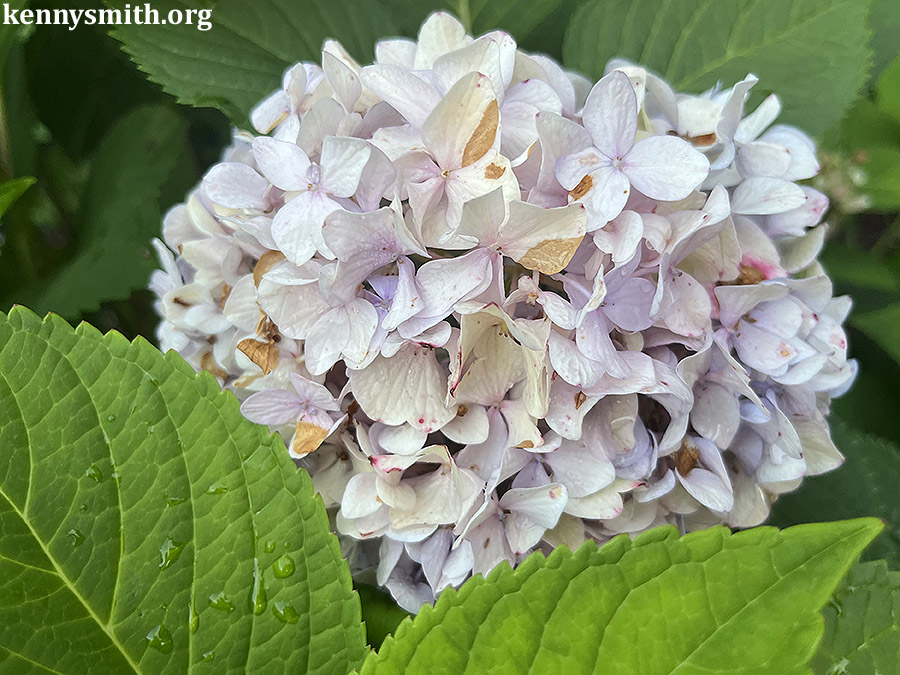
And this, friends, is how you find yourself looking into the etymology of “marcescent.” Probably Latin, but definitely also proto-Italian, or Lithuanian. Possibly Ukranian. Could be Greek. As for the word itself, look it up.
I read somewhere recently that a person should have five hobbies. This hipster think piece of Instagram-quality was implying you’d be more well-rounded, or you could keep them fresh — a new task for every night of the week! — or these things could be seasonal. So I invite you to count the things that are your active hobbies. This does not include work, sleep, family responsibilities, etc.
How many did you get?
Can you see your way into finding the time to adding that third or fourth or fifth hobby? Pretty tricky, right? I would say I have four and practice at three of them. I wonder where the fourth or fifth hobby would go. In this line of reasoning it is something like “At least one of your hobbies takes up too much of your time and gets in the way of other hobbies.”
Well, OK, I do read a lot. Got me there.
I’d like to do more with the website, which has been a state of catch-up since May. But I’m caught up. Now school work time is here. No hard feelings; work must be done. It is happy work, generally speaking.
Can’t ride less. I need to ride more! Fulfilling that hobby’s true ambition would get in the way of other hobbies. Also, there are things I need to build. Critically, there are things I need to finish building. The story of me can’t be the half-finished guy, or the ha-fin-gu, if you will.
That loosely covers the present hobbies, without digressing into their ROI, and says nothing about adding another.
Maybe it was a TikTok-quality piece. Typing this out it doesn’t seem to rise to the caliber of rigor and taste that an Instagram-quality piece would demand. It has the necessary saccharine vibes and FOMO necessary, but challenging you to pick up hobbies that TikTok element of lemmings to it. Who cares how many hobbies you have? Have one. Have 14. Be as good or as bad at them as you like. Pour exactly the right amount of time and money into it as you require. Get out of them exactly what you need.
I had a brief chat with the linguist and author Gretchen McCulloch recently when she was talking about what she called “the great joys” in realizing that she can just go learn to do a new thing once in a while. Take a weekly class for a bit, meet new people, and get, as she called it “medium proficient” at the thing.
This made me smile. I often tell students one of the perks of my job is staying in touch with former students (the one that choose to do so) because it is gratifying to see them develop interests of their own, not what the state or their parents or this curriculum insisted on. So now I have former students who are running for local office, one just received a prominent national AI innovation award (when he isn’t lawyering), softball, travel volleyball tournaments, wandering abroad, hiking close to home, and of course they spend their time with family, have side hustles, or just try new things. I talk about one former student in particular in class too, because it’s not all about curriculum. You want that Paper in college, but my point is always that there’s much, much more to it than that. This of course applies to the rest of life, too. I’m writing about those people and the rest of you and myself, too.
What do we want to do with our time? It’s not a selfish question.
I diverged at some great length into a great deal of text about Type 1 and Type 2 fun. After I deleted that I spent some time writing three more paragraphs about it, that time it was grounded in the idea of how you might find an additional hobby. There are plenty of opportunity and this should be easy, is what I was saying. First you have to define what you want — learn a process, gain a product, make more friends, try the thing that has always astounded you? You can work on these questions for a while.
I’m beginning to see, just now, where my days go.

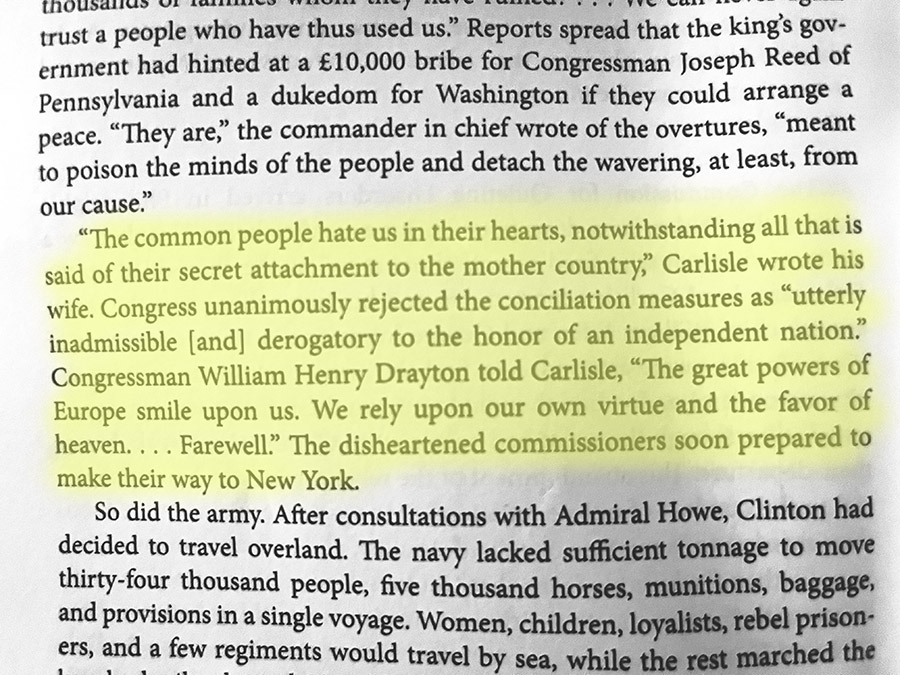
Speaking of reading and learning new things, we return now to Rick Atkinson’s Fate of the Day, the second installment in his Revolutionary War trilogy. It’s excellent. Highly recommended.
From time to time I look up the people he’s writing about. No way in the world you’ve ever come across this young man’s name. And it stands out well enough that we should be able to find him online despite the mists of time.
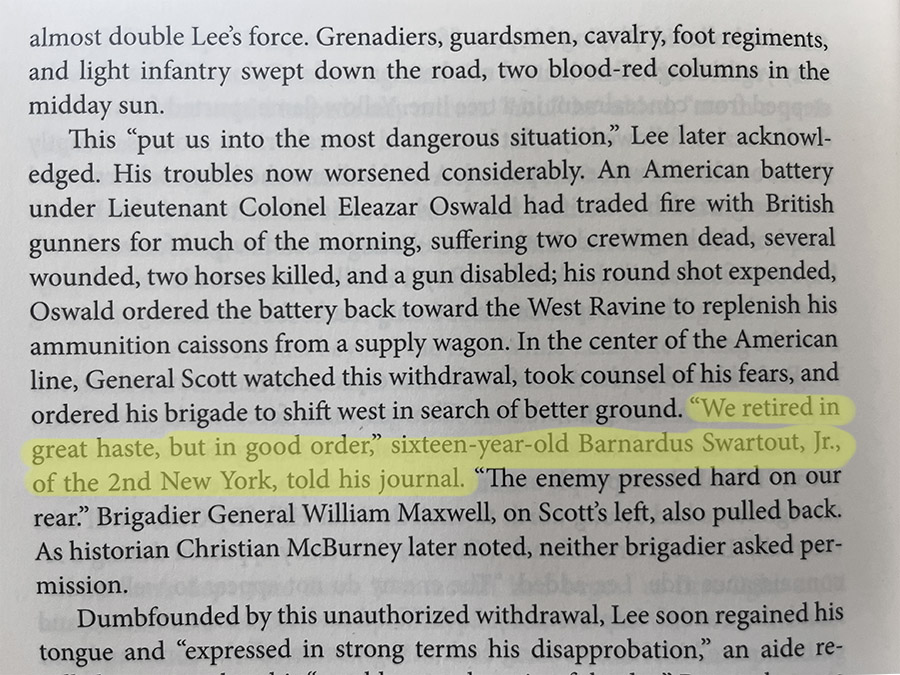
By the time young Barnardous Swartout Jr. played his part in the largest drama of his life at the ripe old age of 16, at least one branch of his family had been in the colonies for four generations. His great-grandfather made the trip over from the Netherlands sometime before 1660. They’d all lived and died in New York, as did Barnardous. The 2nd New York regiment was a part of the invasion of Canada, at Valcour Island, and participated in the battle of Saratoga and Monmouth, which is where we meet him. They were also at Yorktown. How many of those Swartout was at remains beyond me at the moment. We do know he survived the war. He is buried in Sleepy Hollow. I wonder if he knew of Washington Irving’s tale, which was published just four years before he died. I wonder if Sleepy Hollow itself had strong feelings about it at the time.
Barnardus was married the same year as this battle. He and his wife, Mary, had 13 children, at least 11 of which survived into adulthood. He becomes a merchant, and apparently a successful one. He was also a local tax collector, and otherwise paid close attention to politics. He had farmland on the Hudson. If you’ve ever driven over the Cuomo or Tappane Zee bridges you’ve looked down upon his land, some 300+ acres of what he knew as woods, orchards, pastures and meadows. He becomes the sort of local fixture that when other property is written about in the newspapers of the day his place is mentioned as a fixed point. He was also a charter member of The Society of the Cincinnati. He had a two-floor home, multiple barns, and good livestock when he died in 1824.
If you click around enough you can see some of his descendants beginning to move around. I looked at the grandchildren he might have known, mathematically at least. One, was a housewife in Brooklyn, who died at 71. Another stayed in Sleepy Hollow. One served in the navy and two in the army, one of whom died of an illness during the Civil War. Two of his grandchildren survived into the 20th century. (There’s one man, Steuben Jr., that did not know his grandfather, Barnardus, but did live long enough to read about the horrors of World War I.) Some lived in Pennsylvania, Ohio, Michigan, Iowa. Some had large families themselves; others, perhaps did not. Maybe having that many brothers and sisters was enough. (Online record caveats also apply.) They were Masons, Quakers, they had spiritual epitaphs, they were American. If there had only been a reference in here to a canal this man’s family would have been a complete reference to early white U.S. history.
That family name is also still in New York. Hopefully they’re in good order.