31
Aug 26

The first last day of the summer

It was a calm weekend around here. There were two big highlights. Someone ordered a pickup meal from Longhorn Steakhouse in Florida and used my email as the space filler in Darden Restaurants’ data mining operation. I made fun of their meal. Why do you order seafood, in Fort Lauderdale, from a steakhouse?

And why do you order it for curbside pickup? Do you like lukewarm fish? And chowder? In August? It was 80-something degrees in Fort Lauderdale this weekend. Did you need to warmup? With a shrimp lobster chowder?

How does strawberry lemonade even figure into this? I’m no purist about lemonade flavors, or so I thought, but the more I thought about all of the bad flavors in this styrofoam box and paper bowl … lemonade should be lemonade flavored. Otherwise you’re just telling me about a lifetime of taste bud punishment you’ve inflicted on yourself.

All of this, somehow, costs 41 bucks. But not me. It wasn’t my meal. I did get a survey, and don’t you know I filled that out. I made several pointed comments about Longhorn, and their curbs. But not their service. No need to cause problems for the people working there.

And don’t you know? It worked.

I got a coupon for a free appetizer. There isn’t a Longhorn within less than a half-hour from here, so who needs an appetizer?

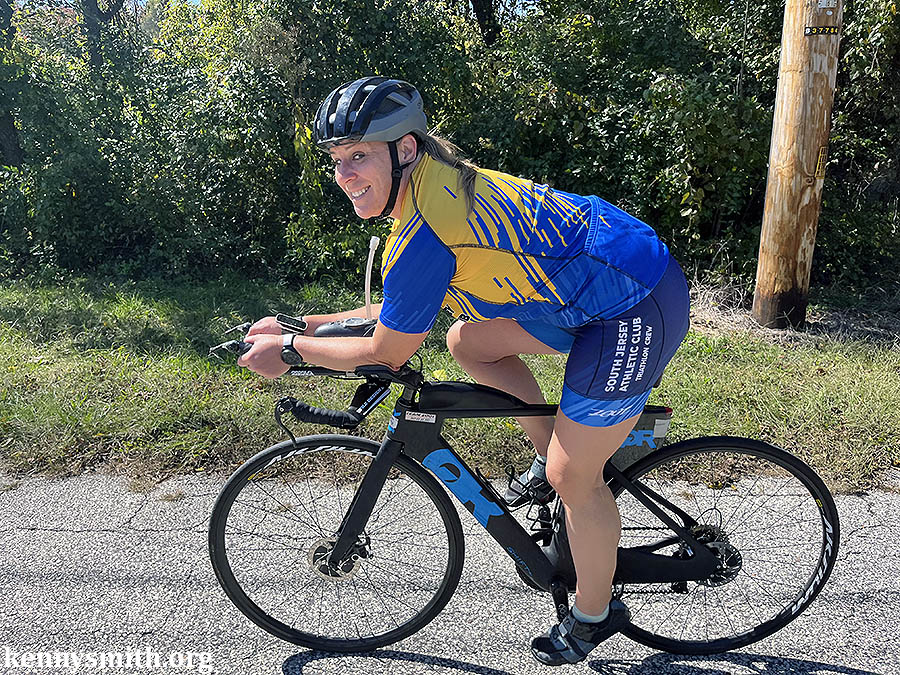
The other thing that happened was that my lovely bride did her first time trial this weekend. Just you and your bike against the clock. At the end she found herself on the podium. Third place is great! And enough to send her back again for more.

Otherwise, this weekend was the deep breath in before the semester begins. Classes start on Tuesday. At some point on Sunday I stopped stressing about it. It’s weird. I do more work throughout the term, of course, but I’ve spent a lot of time working on stuff and trying to layout materials and anticipate problems — and then throwing some of that work away and starting over because of, sigh, reasons — throughout August. That whole time has been worry, one stress, one series of second guesses after another. I figured that would all go away after a class or two, or a a few weeks. It usually does. But, last evening, it just disappeared. The classes will be the classes and they’ll be useful and we’ll do fine.

It’s let me do other things. I cleaned one corner of my home office this weekend. And I did a lot in the on-campus office. The Yankee and I have been sharing an office for the last two years, but she’s being moved to a different building, and we moved her this weekend. I’m keeping the old office, so we packed her up Saturday. I brought in a big box of books of my own, which have been sitting in storage for the last three years. I rearranged the desk and generally lamented losing my roomie. What, we’re just supposed to see each other at home? That’s hardly enough.

We had a nice reading date this weekend, and so I point once again to Rick Atkinson’s Fate of the Day, the second installment in his Revolutionary War trilogy. I’m in that bittersweet part of any book you enjoy. You want to plow through it. You want it to last forever. This is an excellent read. Highly recommended.

But I have once again had it confirmed for me that I wouldn’t want to be an 18th century sailor. I’ve been sure of that for a long time, but that impression is confirmed.

There was a bit in here about some French sailors who had been kept on their vessels for more than a year, the details of which were inhumane. But that’s war, and that was navy life, and they didn’t have the comparative advantages of the USS Abraham Lincoln, the sailors of which, by all credible reports, have been on a nightmare service cruise.

If you have the opportunity to have three different people come out to do work on your home in one day, definitely don’t do that. We did that today. It took up the whole day, about six or seven hours, but it was productive. First, we had a guy come out to give us a quote on chimney repairs. There are a few light problems outside and, distressingly, we had some water get inside during last Thursday’s monsoon. That first guy glanced at the chimney from the ground, said we needed a new crown, that his shop would make a customized job. We talked about the stucco. He came inside to look inside the fireplace, and found some problems. He quoted us a price off the top of his head and asked for a 50 percent down payment. We asked him to put his quote on a piece of paper and sent him on his way.

We had an electrician come out, his second time here. Nice fellow. This is the end of a saga that has stretched from April to now, and involved four different companies. He stayed and worked for a long time, trying to figure out the intricacies of this, and the idiosyncratic wiring that had been done to that. Finally, finally the poor guy got things the way they should be. (One of those companies that had been … let’s say involved … won’t be getting a lot of calls from us in the future. They’ll get a letter. I’m pretty close to naming names.)

As he wrapped up his work a second chimney guy came. He deployed a drone so he could actually see what was going on up top.

The previous guy just glanced up that way. We talked about the problems and the options. He had a sneaking suspicion that he could fix that leak straight away, so I trimmed the hydrangea for easier access while he sealed up the flashing. That paired nicely with the spot weeding I found myself doing while chatting with the electrician earlier in the day. Then he, the chimney guy, did some sealing of the places where the lower levels of the chimney touches the house.

He came in with photos, and showed us the before shot of a big hole in the stucco, and someone’s slapdash silicone solution. He said he figured it’d been there for about 10 years. As ever, we muttered the previous owners’ name.

So maybe the leak is fixed. As our guy said, we can’t interrogate the water. If it comes back inside in the next huge storm, though, I’m certainly going to try.

Anyway, that was the weekend and Monday. Somehow I got done, today, all of the things I needed to do — emailing this class and that class, changing some settings on Canvas, doing a little roster prep — but none of the other things I also wanted to do. And that’s OK. They’ll be there for another day. Just not tomorrow. Classes start tomorrow!


28
Aug 26

The platonic ideal of Fridays

We had rain yesterday. We also had a tornado warning, and while my lovely bride grabbed one of the cats and took shelter in the basement, I looked for the other cat. I kept an eye on the radar, an eye on the windows and a third eye looking for the cat, which explains why I couldn’t find her. She came out promptly when the worst of it passed. And the worst of it was atmospheric rotation. And a lot of rain. The three nearest weather stations recorded totals of 4.49, 5.31, and 7.11 inches. Whatever amount we had it was enough to show you where water can come in. And so Monday we’ll have some people out for quotes on how to keep the rain outside, rather than inside. (We have a slight chimney problem. We also have a slight backwash problem in the basement. Having fixed one of those already I know that one will be easier to correct.)

I watched a garbage can float down the road. Someone up the hill hadn’t retrieved theirs for the day and so the thing, lid open, just drifted down the hill on the water. It lost its balance right near the bottom, and fell onto its side in the road. By the time I went to the window to look at it again it was deep into the neighbors’ driveway.

Someone’s going to miss that in a few days.

I had an abstract due today. OK, it is was due Monday, but we’re in that time of year where you are still trying to be ahead of things. So I wrote a 300 word abstract. This takes more time than you’d imagine, but isn’t overly difficult. The problem, as ever, is anticipating what your audience needs and wants, and figuring out where they can make an inferential leap. If your finished paper is 8,000 words and you have to sum it up and tease it in 300, you’re necessarily leaving some things out. It takes a few drafts, is all. And that takes a little time.

Also, there were emails to navigate. Next week email navigation will turn into email negotiation. Then there’s plea bargaining, desperation, and ‘Won’t you please just leave me alone?’ But, if you stay on top of it, you can avoid that for the most part. I stay on top of it by treating my inbox like a To Do list. If I don’t want to To Do it right now it just To Sits There. Or, sometimes, if I don’t want to To Do it I put a particular email in a To Folder, where it will no doubt sit long past its usefulness or my recollection.

I send more emails to my inbox than anyone else does. It’s littered with links to something that might be useful in this class or that class. My recent innovation has been to sort them all into folders for a given class. Now, when I need a new AI example, or an anecdote about, say, stadium operations, I just have to go into that folder. The problem is my innovation isn’t innovative enough to let me sort the emails in the folder accordingly. There they sit, chronologically, waiting for me to sift through them, often trying to guess the subject matter by URL. Perhaps next summer’s innovation will be organized email folders.

Should I start a list of next summer’s projects already? Should I even have a list of summer projects?

Anyway, there is a lot to do. Now, not just next summer. I did a little of it today. My classes are prepared for next week, I think. (One more pass on Monday, the hustle begins on Tuesday. The hustle actually begins Monday. I have to write my opening note to the online class. I have to print out rosters. I have to make sure everything is squared away for the week. I have to settle into the new weekly schedule I’ve sketched out. Basically, Monday I’ll be an entirely different person.)

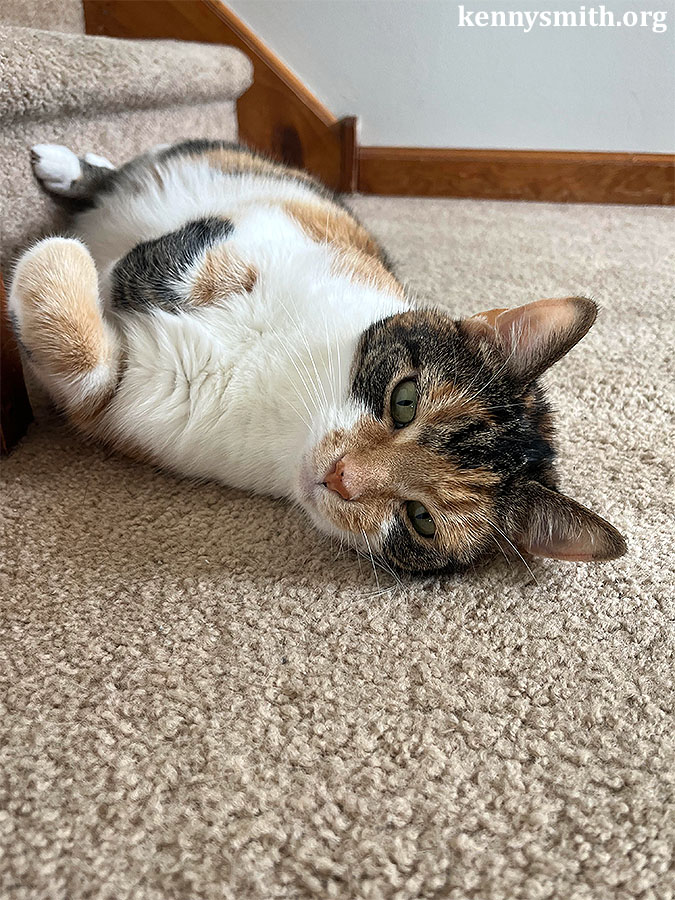
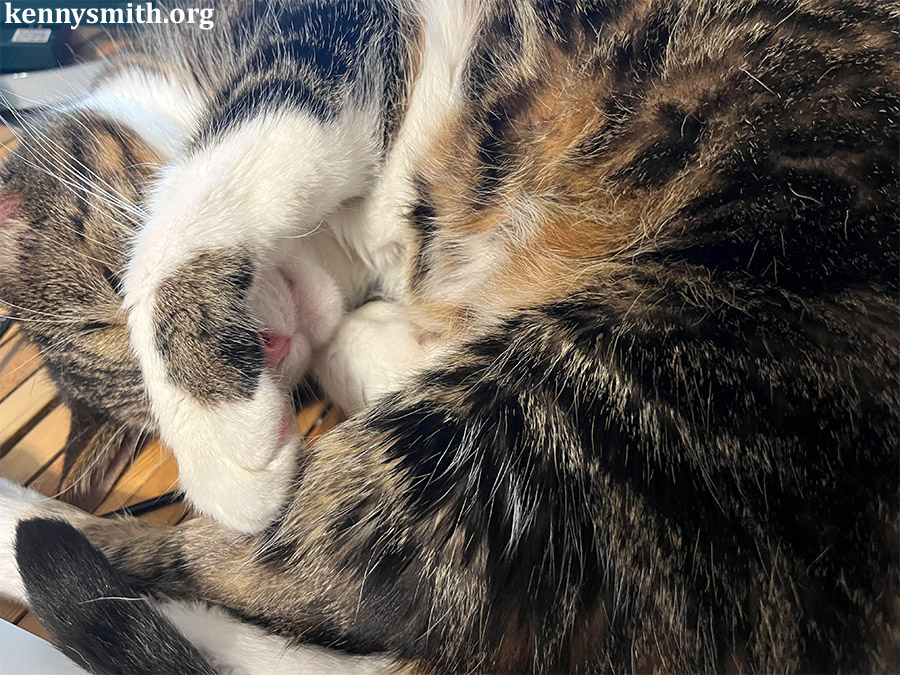
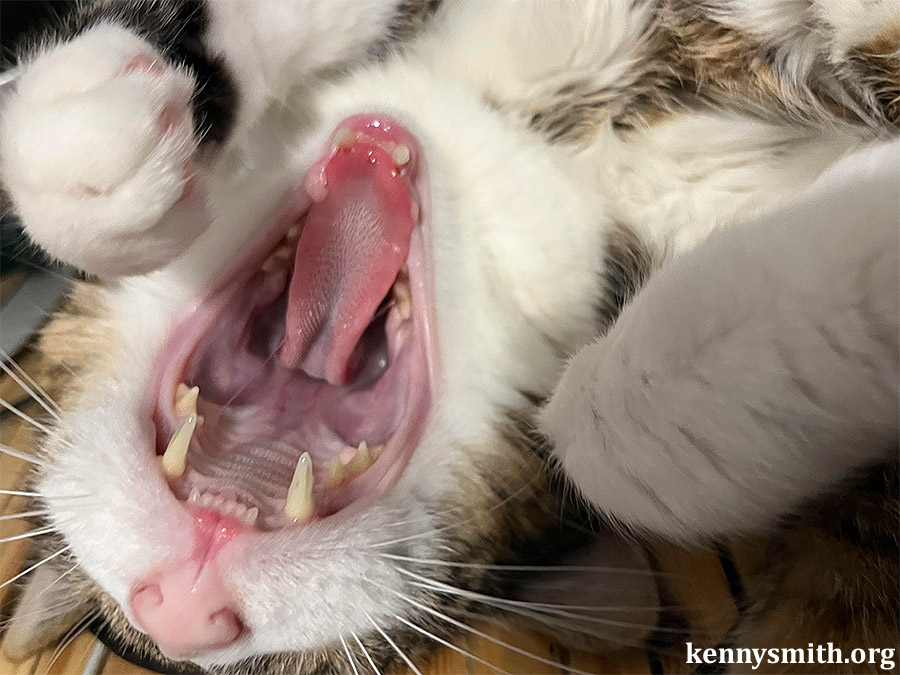
Try explaining this to the cats, who just want their weekly feature — the site’s most popular feature — and also pets, and treats. Phoebe has an idea about those treats.

And here she is, in the new tunnel, thinking tunnel thoughts, I’m sure. We have lots of places where the purpose seems to be I hide here but it is never clear on what we’re hiding from. I’m sure it is instinct, and who are any of us to argue with instinct.

Just look at how handsome this face is. If Poseidon put as much effort into not being a jerk as he can put into being charming … well, we wouldn’t think he has personality issues.

He can be very sweet. Very demonstratively sweet and peaceful, which makes his random outbursts seem all the more rude. Also, he’s a big fan of this book. I’m not sure if he’s a fan of my reading it, however.

Here he was, laying on it last week. A book on a lap might be a highlight for a cat. Who are any of us to argue with instinct?

Speaking of that book, we return now to Rick Atkinson’s Fate of the Day, the second installment in his Revolutionary War trilogy. It’s excellent. Highly recommended.

There are reasons some of the disquieting stories from the Northwest Territory don’t make it into school books. You couldn’t tell the story of Fort Sackville and think there are any good guys at all in the Revolution. Good grief.

Another one of those stories would be the Sullivan Expedition against four British-allied tribes of the Iroquois Confederacy. Congress told our man George Wahsington to do something about it and he, who had fought indigenous people before, had ideas on how to do this. He also was probably ready to go on the offensive after having spent so much of the war dodging and daring the British. So in the summer of 1979 he sent Gen. John Sullivan on a particularly grim task.

Sullivan started late and perhaps didn’t fulfill his objectives to the utmost, but was nevertheless effective. The Haudenosaunee, allied with the British, had raided some white settlements in upstate New York. A few doen people were killed in one such raid, some 300 are estimated to have died in another, at the Battle of Wyoming Valley, and late in 1778 some 30 people were killed in a horrific manner at Cherry Valley. and this was in retaliation for that. It had become clear that offense was what was needed on the frontier. In all, funds were appropriated, orders were given, men were mustered, Sullivan (eventually) stepped off with about 4,000 men. When it was over some months later, his force had razed some 40 villages, with thousands of people trying to survive as refugees and no crops to feed themselves. The estimates suggest that a few hundred natives were killed during what we would today call combat operations, but perhaps several thousand more would perish from disease or starvation.

And now historians debate the thing. Was it genocide? Some, but not all, have said as much.

There are monuments to the Sullivan expedition, dozens of them along the route Sullivan’s men marched. There was a stamp issued 140 years later. By the bicentennial, in 1979, things had become more subdued. There are also reenactments.

You can read some of these details here. But you should also rush out and get Atkinson’s book. It’s terrific.


27
Aug 26

The 1926 Glomerata, part one

After a long time away from this feature, we return to the dusty old pages of old yearbooks. Enjoy a few pretty pictures from the Plains.

We go now to the 1920s, right in the middle of what might be the tumultuous era in the old alma mater’s history. Spright Dowell, who never enjoyed support as the president, was coming to the end of his time on the plains. He’d come over from the state department of education, which even, back then, referred to itself as The Department. Dowell replaced Charles Thach, an alumnus who’d been on campus for decades until 1920, just before his death the next year. They were engaged in political warfare with their cross-state university rival (with cloak-room maneuvering that went far beyond athletics.) State funds were low, there were charges of ethics problems through the Cooperative Extension Service. The university also had to survive a proposal that would move the campus 50 miles west, to the capitol city. Dowell wasn’t exactly against that idea, and that cost him in the eyes of his faculty and students. Also, the Great Depression was on the horizon. No one knew that in 1926.

Dowell knew, however, that he replaced a beloved man, and sometimes blamed that for his lot in life, because the real issues — disrepair of buildings, outdated equipment, debt, underpaid faculty — weren’t enough to blame. He wanted more money from the state, which often looked at the university as a secondary concern, despite its land grant status and importance to the region. People seemed to like him, there was a complimentary note about his welcoming style of conversation in this annual, but didn’t think he was equal to the job. He’d lost the alumni, the faculty were over him. Enrollment wasn’t keeping up with regional competition. Dowell might have been too much of a holistic bureaucrat for the moment, and didn’t bring the requisite passion for the place, but there was also the problems in athletics, particularly football. After the 1924 season the team was 4-4-1, and alumni wanted Dowell to be brought before the board of trustees, with students called to testify. This was the lever that moved alumni, but statewide politics that had nothing to do with sports were also at play. The students hanged him in effigy.

This is the cover of the 1926 yearbook.

The book was dedicated to Maj. John Everard Hatch, “who has been an inspiration to us throughout our four years of college life … in token of our love for him as a man, our admiration for him as a solider and our devotion to him as a leader.” Hatch retired as a colonel. He and his wife, Helen, are buried at West Point. They had a daughter and two sons, both of whom served as officers in the Army. They would have all been 10 or younger here. His father was a brigadier general, buried at Arlington.

Sometimes it is easy to think of the way-back-then as a monochrome moment, a sepia-toned, yellowed piece of paper is what we’ve got. That’s what we see, after all. But this book is here to show you, they knew about color. There are several plates like this marking the different sections of the book. Though, to my knowledge, we didn’t often have tigers walking a path to Samford Hall.

Nevertheless, it is the 1920s. The photos here are large shots of buildings, which we’ve discussed before, and small headshots, like these, of the senior and junior class officers.

Vice president of the senior class was Leon Nelson, who was from Gadsden. He went to Florida to coach and then to coach in south Alabama. A decade hence, he was the head football coach back home in Gadsden, and had a legendary decade-long run there. He went back to Florida in 1948, where he stayed until 1964. The stadium there is named in his honor. He died at 67, in 1970, in Miami.

Owen Frederick Wise return to Auburn in 1970 to receive an honorary doctorate. He was the director of the state’s Vocational Rehabilitation Service where he worked for more than 40 years, started in 1928. He died in Montgomery, in 1973. He had his wife, Louise, had two daughters, and at least one of them went to Auburn and would be listed as one of the Glomerata’s favorites — a fact which was mentioned in her obituary, at 88, in 2023.

Louis Howle left school and signed on with the American Telephone and Telegraph Company, where he worked for 43 years. He and his wife had two daughters. He died in Atlanta, in 1983.

Robert Young Brown went into the foreign service. He was stationed in Baghdad, Cairo, Bogota, and Panama in the 1930s. He would also serve in Montevideo, Manila, and Athens. He was named consul general in Jamaica in 1950. He retired in 1957, and served in the National Defense Executive Reserve. He died in 1964.

Dorothy Duggar was from Auburn, hers was one of those reasonably prominent families. She would become the first woman to graduate from the university with a degree in architecture. She stayed in town, and became well-known herself. She died in 1975 and is buried at Pine Hill.

Did these juniors do much? Eldon Pruett got married in the fall of 1926 and graduated in May of 1927. His wife became a teacher. He did too, becoming a coach at neighboring Opelika High. He stayed in the Army reserves, left OHS to serve in the war. At some point he did a stint in Korea. He became a lieutenant colonel, and a business manager when he returned to civilian life. He was active in local society, ran for the county school board, married off two daughters. His nickname in college was Dizzy, and people still called him that three decades later. He died in 1968.

S.H. Lynne was a track star at Auburn and was hired as a coach at Alabama. He also studied the law there, and then became a county judge in 1934. He was named to the federal bench in 1946 by Harry Truman. When he died, at 93, in 2000, he was the longest serving jurist. His obituary recalls that his order kept George Wallace from barring two black students from attending the University of Alabama, though he wasn’t known as a proponent of integration.

His classmate and fellow class officer Moreland G. Smith was a civil rights activist, and architect. He joined a Nashville firm, studied at MIT, and then put out his own shingle. He designed a city hall, and an apartment complex where Rosa Parks would later live. He served in the Army Corps of Engineers. He later designed Montgomery’s Garrett Coliseum, served on the board of trustees at Tuskegee. He also worked on a church, a library and three county courthouses. He sold most of his interest in the architectural firm Sherlock, Smith & Adams because the very racist governor was threatening a bank with which they did business. He moved to Atlanta and joined the Southern Regional Council. He and his wife, Marjorie, had three children. He died in 1989.

It looks as though Rodney G. Carter became a teacher, and then a principal. He’s difficult to pin down, however.

All of the senior headshots look like this, though Sarah Frances Blackman is the only one smiling.

If I have the right woman, it seems that she got married in 1953. It’s possible she lived in Florida. And, if I found the right one I think I’ve just stumbled upon my favorite newspaper mention in this long-running project. In 1983, Frances Blackman was demonstrating the microwave. No wonder she was smiling, decades and decades earlier.

The next woman is Mrs. Margaret H. Blair. She would go on to work at the Georgia Teachers College and the University of Georgia. By the mid-1940s she becomes nationally renowned in clothing and textiles. She’s in her 30s here, but she’s difficult to trace. She died in Savannah, Georgia, in 1973. Her sister, Agnes Harris, was at this time the dean of women at Auburn. The next year she went over to Alabama.

I only included the third guy because he was easy to find. Samuel Bonifay studied electrical engineering, became a meter tester, and eventually settled in Anniston, working for Alabama Power for almost 40 years. He served as a captain in the reserves, retired in 1966 and had a daughter and two grandchildren when died at 75 in 1977.

On that same page, at the bottom of the column, is Margaret Brown. She was studying education and, if you’ll read her blurb, was a total jock.

The varsity team didn’t form until 1971, of course, but women were doing things prior to that. And this, in 1926, is the first time I recall the yearbook bragging about it. Unfortunately, the athletic department doesn’t record or recognize those earlier teams. And Brown, of course, is quite the common name.

This is Wiliam Alton Goode, he was studying agriculture, livestock in particular. He’d eventually own a dairy concern. He died in 1979, age 75, the father of a son and two daughters. He is from one of my ancestral haunts and I bet someone in my family knew him.

I don’t profess to being an expert on the photography or portraiture of the era, but I bet this woman, Oriel Nevada McGinty, was desperately ready to be done with the 1920s.

She was the oldest of five from nearby Camp Hill. She was to become a teacher. She died at 86 in 1976.

It is a shame the photo isn’t bigger, but you can tell that the band is awfully proud of those capes. I bet they were new.

“They weren’t good, but they had rifles, and so we’ll say whatever nice things they want us to.”

Earlier we learned that the athletics were struggling. The solution was a rebuild. The university brought in David Morey, center. He was an All-American football player for Dartmouth College and a pitcher for the Philadelphia Athletics. Auburn was his third stop, where he stayed for three years. He went 10–10–1 in football, with the high water mark being a 2–0 win against Tulane in the first game of New Orleans’ Sugar Bowl. In 1927 his quarterback was expelled for sneaking into a women’s dorm after a night of drinking. (Could you imagine that headline today?) His team started 0–3 and he resigned. he went back north to coach again.

Some of these other guys would have distinguished careers on the plains. These guys all came in together, Red Brown, who coached the freshmen, Boozer Pitts, Morey, Mike Papke, and the great Wilbur Hutsell.

Pitts was a local boy, and was a standout player at Auburn in the glory days. He was a center at 190 pounds. He’d coached the team in ’23 and ’24, and would step in for Morey in 1927. Aside from World War II, when he served as an army officer, he taught math at the university for more than 30 years. He died in 1971.

Papke would coach the basketball team for three seasons and still has the second-highest winning percentage on campus.

Wilbur Hutsell was fast his whole life, being a conference champion in the 400 when he was in college. He’d been on campus for a few years as the first track and field coach. In his career he sent five athletes to the Olympics. He also coached the basketball team for a time, before Papke came along. He trained the 1924 Olympics wrestling team and was an assistant track coach for the 1928 Games. He was also the athletic director, twice. The track venue on campus was named in his honor and he was inducted into four different halls of fame.

Morey, on the gridiron, had guys like this to work with. No idea who they are, as there’s no caption. The football team began their rebuild, in 1925, going 5-3-1. The yearbook says they were a thin team. As yearbooks must do, they were incredibly optimistic about the future.

They were wrong. The team would go 5-4 in 1926 and wouldn’t see a winning season again until 1931. None of the fans knew that. Some 5,000 fans came out to see the homecoming game, a 19-0 loss to Virginia Tech. It was the largest crowd to ever watch Auburn play. In contrast, the 2026 A-Day game, the spring scrimmage, had 34,276 fans in attendance.

There were quite a few on hand for this game. Not sure where it is, but I want to say Columbus. The sports photography had a long way to go, in the 1920s, and this is the best of the shots assembled here. But, still, look at that referee running in at the end of the play.

This is the captain of the team, Edward “Red” Hawkins. He was a senior from Bessemer, studying civil engineering. He got married in 1928 to Mildred and graduated in 1929. He taught and was the athletics director of a high school for some time. He joined the U.S. Forest Service and then the war came. Overseas for more than two years, he was stationed in Calcutta, India for at least part of that time, where he was promoted to lieutenant colonel. Ten days after his 90th birthday, in 1992, he died in south Alabama.

This is the rat football team. The freshman team, and the first one in the university’s history. It says here that some 120 “freshies” came out for the team. Twenty-two of them are listed above this photograph. It looks like a pretty fierce group to me.

Cheerleading was different then. These guys didn’t merit a real mention here, but they did get this photograph. I wonder if they had to supply their own white-on-white cheer uniforms. We do learn the cheer leader is Charles Roberts, a junior from Wadley studying electrical engineering. He’s the guy in the middle.

Roberts worked at Georgia Power, where he was a vice president for a quarter century. He cheered on the Red Cross and the United Givers as chairman of the local fund drives. He’d been president of the Rotary, the chamber of commerce and the Georgia State Fair Association. When he died, at 67 in 1971, he had a son and daughter, and seven grandchildren. His wife died three years prior, almost to the day.

Here’s the captain of the basketball team, which earned a two-page spread. Bill McKinney was from Mobile. He was studying electrical engineering. The season was still underway when the Glom went to print. They finished 5-10, but were looking forward to better days. And the next few seasons were better.

McKinney came from a time before load management. We learn here that he’d played every minute in the last two seasons. He made it to 98, his time at the university and his four varsity letters, his time in ROTC, and his being a team captain are sentences three through seven in his 2003 obituary. But he was more than an Auburn Man — they for sure got that in his obit, as well they should. He was in the Rotary Club. He worked for the American Blower Corporation, which made industrial fans, for two decades. He started McKinney Associates in 1948 and, it says here, he never missed a day of work until he retired at 97.

One of the guys on the team is the great Emil “Snitz” Snyder. Streak was his college nickname for a time, and he came by it honest. He was a three-sport start, but it was the track where he shined. He held the American record for the 300 meter race for a time, at 48 seconds flat. He ran the 100-yard dash in 9.8 seconds. In two years he would become Auburn’s first Olympian. He would win a heat race in the 400 meters, but didn’t advance past the quarterfinals.

After school, Snyder coached football for 30 years. I grew up near a stadium named in his honor. The mayor said “Everyone didn’t love him — no man can claim that — but everyone respected him. Not many can claim that.” Wilbur Hutsell, who we met above, said “I never played for Snitz. I envy those more fortunate.” The newspaper wrote “He produced so many outstanding athletes for Bobby Dodd at Georgia Tech that he was often accused of running a Tech training camp.” He trained at least three All-Americans and one football national champion. He won seven state football championships. His basketball team was a state runner-up. During World War II he ran a physical fitness program on a college campus. The Boston Celtics came to town and his team beat them. He died, at 72, in 1978.

This is Cecil Stewart, captain of the baseball team. The Glom says “his uncanny ability to wield the willow and handle the horsehide is sure to carry him to the top.” Those are both baseball references, though I had to look up the first one. Stewart played seven years of minor league ball as a second baseman. Soon after he hung up his spikes he got married. He and his wife, Catherine, started their lives in Dallas. Geechie, as he was known as a young man, died at 85, in 1988.

Here’s one more baseball shot. The guy on the right is Ben Sankey. They bragged about him here as a shortstop, and they weren’t wrong. He spent three years in the bigs, playing all around the Pittsburgh Pirates’ infield. He died in Georgia in 2001, at 94 years old.

Last one for the day, these are the track and field captains. I’m not sure what the Ts mean on the uniform. Leon Lavert “Nurmi” Nelson has them, but the whole team does not wear them. Nelson was also the vice president of his senior class, we learned about him, above.

The other guy is George Clifford Murrow. He ran cross country. He got a masters degree at Alabama. He became an educator, and then a principal, which was one of his job titles for 32 years. In the summers he worked as a funeral director. He retired in 1971. He died in 1988, survived by his wife, Ola May, and two daughters.

All of these will wind up in the Glomerata section (eventually). You can see others, here. Or maybe you’d like to click through to see all the covers. The university hosts their collection here.


26
Aug 26

Another day closer to being ready for the semester

Another one of my classes was locked down today. I’m sure I’ve said that recently. Probably about that class, but it is official official now. The syllabus has been uploaded. I’m not touching anything else with it, build-wise. Of course I have to work on lectures, but there’s time for that. For now, it is organized and mostly coherent.

The last thing to do was to fix the syllabus. Change the dates. Change the time and date details. Add some standard university boilerplate. Wonder why this was a nine-page document. My afternoon goal was to cut that down. Eventually, I made it five pages. Here’s how you do that.

You press the delete button a lot.

When you add things you have to delete things. Paragraphs and sentences can be made redundant. Then you can move sections around to take advantage of page breaks. Then you can reduce sentences to their Hemingwayesque destiny. Finally, you can just delete a whole two-page section with information that exists elsewhere, anyway. Voilà! Five pages!

If you’re not leaving the bulk of your work on the cutting room floor, you’re not doing your best work.

I also locked up my online presentations class with a new thumbnail image: owls staring at a computer. Tomorrow, I’ll go through my org comm class once more to make sure that it’s ready. Monday, I’ll put the finishing touches on the first week’s slide decks. Tuesday, I’ll hit the ground stumbling.

If you wanted to see the new sunglasses shelf in its natural location, and I’m sure no one did, here it is. One piece of scrap plywood for the back, two bits of leftover pine for the sides, one of the rip cut to match the other. Two other pieces of extra wood crosscut into shelves. Glue on the sides, brad nails on the shelves. Wood screws for the cleat, which was was also leftover. Six shelves, lots of sunglasses.

It does what I wanted it to do.

I hate it already.

I do not know why my lovely bride has two helmets in the garage. She can only wear one at a time. (She has at least three active helmets right now.)

The sunset looked promising from the backyard.

Over at the north corner there was a nice mixture of colors amidst the tangle of plants. The roses and the hydrangea are having a fine time of it. I think we might have developed a second hydrangea in there, somehow. Just there on the right the famous honeysuckle is sneaking into the shot.

Looking to the west, the sunset got serious quickly.

That’s a good argument to knock off work at key times. You can only catch that by chance unless you make the actual effort. Make the actual effort. You don’t want to miss views like that.


25
Aug 26

Back to it

Today was a day of waking up at a reasonable time. I had forgotten there was a 7:30 a.m. I am not the morning person. I’m fine when I wake up, but just let me sleep in. It’s my natural condition. So imagine, if you will, the 10 or so years I did morning news. I had one job where I was in the studio at 4:30 a.m. That might the next job’s 6 a.m. arrival seem positively easy. The upside was that you had an afternoon to get errands done. The downside was you can’t, in your 20s, convince people you need to be in bed by 8 p.m.

Reader, I never was.

I was not last night, either. I only had to wake up at 7:30. This was rude enough.

Fortunately, my classes are all in the afternoon and evening.

Anyway, we had a meeting at 9:30 a.m., our first faculty meeting of the semester. This involved sitting in a classroom, reading an agenda, talking about the various items. Trying to stay on track and on schedule, and so on. (This group has a terrific sense of staying on time, and that’s a nice thing to be a part of.) It ran for six hours, this meeting. Six hours is not easing back into things. I suppose all of the work I’ve done these last four weeks have been the easing back into things. And, also, the sudden increase of email that has coincided with the work. Perhaps that has been the easing back in. (Just four more days of easing back in until the full stride begins. But I don’t want to wow you with all of that just now.)

The good news is that we’ll be on the clock for the work next week. Once we get started, then we can get started. The feeling before classes begin is an odd one. It is a stew of excitement and anxiety and you-still-have-time and you-have-no-time and there-are-days-to enjoy-yourself-so-relax and who-can-relax and, also, I-need-more-days-with-which-to-relax. This paragraph breaks no new ground — as opposed to every other ‘graph on this site. It has always felt like that. I suspect the days before a new semester begin feel like that for a lot of people. I imagine it always will, at least so long as we have semesters and people teaching in them.

And now, notes from real life.

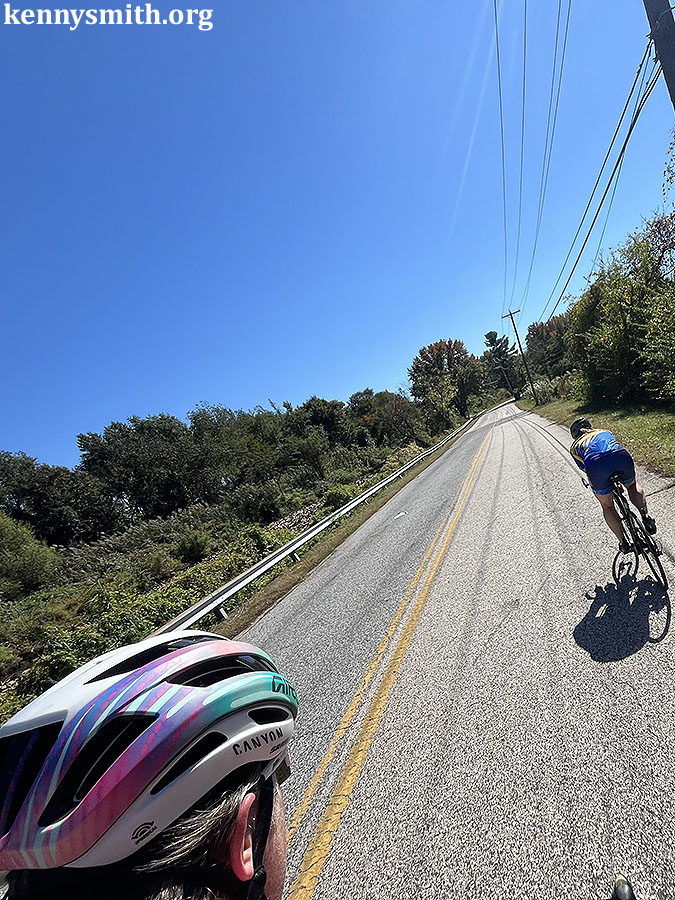
We went out for a morning bike ride yesterday. A simple 20-miler, one of the traditional routes. I decided, wisely, that instead of trying to stay out front for as long as possible, I would ride sensible, hanging onto my lovely bride’s wheel, and then maybe I’ll still be there at the end. Going out front would have probably been a better option. She’s riding so well lately and I am not and that’s how you find yourself going 20-plus miles an hour and squinting into the distance, trying to determine if you can still see someone in the distance.

Nothing on that ride was terribly bad. She’s just super great at the moment.

Some farmers, in some places, talk about a second season. We have that here, and here’s evidence of that. I rode this same route a few weeks back and the corner was taller than me. Now, it is not.

This, if I remember my corn growing rates, is pushing the boundaries of the science, which is pretty cool. Double-cropping is a growing thing, and I need to read more about it. I can’t recall if it is efficient or inefficient. (Most likely that depends on the crop.)

For today’s bike ride I recreated a route I did three years ago, this week. It was a ride-every-road-within-shouting-distance-until-you-get-to-20-miles route. I did it at just below a tempo pace. I finished it two minutes and two seconds faster than I did in 2023. I wish it had been faster.

After my ride I finished this project. It’s the same picture I shared yesterday, because the face of it looks the same. This evening I had to attach the cleat to the back. From there, hang the cleat on the wall.

This took four screws, but they had to be precise because the cleat isn’t quite large enough. The cleat isn’t quite large enough because it is a leftover cleat that I made last summer. I got a corner cabinet and mounted it in a dead space in the garage and there sit the bike shoes and the helmet. All of this was an effort to get the bike stuff all the tool stuff. Only, lately, the sunglasses and have migrated back to the tool stuff. So, I had some extra lumber and wanted to try my new brad nailer and everything worked out well. Until I had to get those screws in. There were about three millimeters for error because, again, I cut twice and measured once on this project. It is garage furniture.

And now it is sitting on a wall cleat and holding sunglasses and it doesn’t even wobble when the garage door goes up and down.

There are no cats in this tunnel. Phoebe ran into the room for attention and settled down in her favorite spot for speculative belly rubs. I gave her a nice pet and then shot this, just because I like the way the light was playing off the tunnel.

That’s a new tunnel that my mother sent the cats. We now have two tunnels, so our jealous sibling cats can get along with one another. I’d randomly move them around the house, but these little guys are such creatures of habit I’m not sure how they’d react to upsetting their routine with such an offensive gesture.

Outside, I looked up just in time. This plane is going to London. By the time you read this, of course, the people are already there. Probably over the jet lag. I wonder what they’re doing today.

Sometimes you should look up even when there’s no rumble or roar of an aircraft overhead. Sometimes you just get lucky. Just about every time, really, if you think about it.

Think about it.