These are stay-inside days, if you like things like breathing. And, it must be said, there a lot of places with worse air.
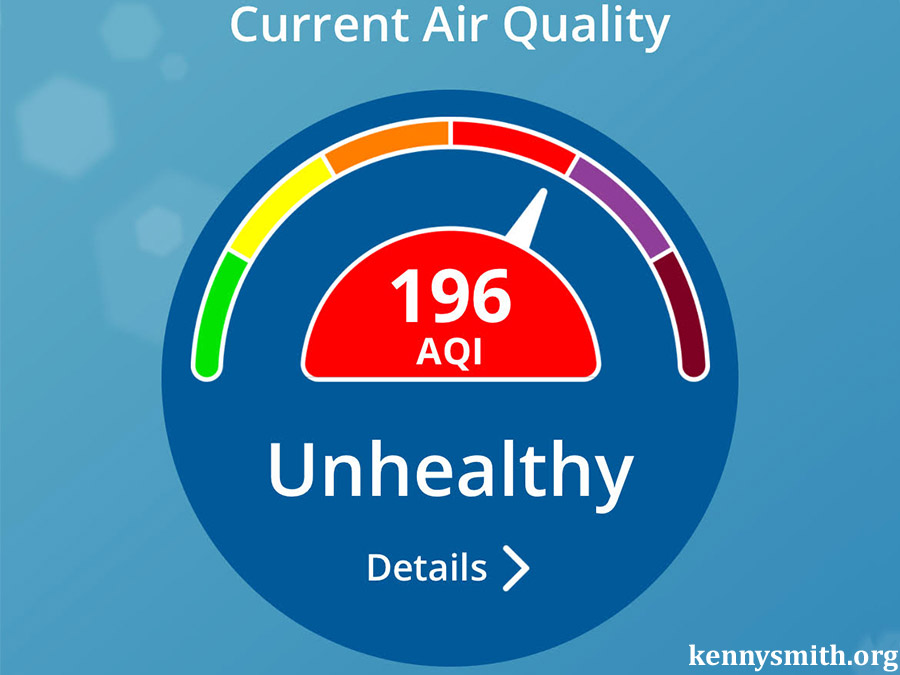
That we’ve let it come to this.


|
These are stay-inside days, if you like things like breathing. And, it must be said, there a lot of places with worse air.
That we’ve let it come to this.
However hot it was yesterday, and the heat index reached 110 degrees, it felt much the same today. The heat index reached 108 today. I am of the opinion that anything over 106 is just pain, anyway. The rest is semantics.

Except for this, those poor electricians were back at it today, running wires and cables and connections this way and that, all so that we might one day have a generator operational. They sweated and melted and crusted over and sweated again. They had to turn the power off today, which they did one minute after their projected time. They predicted we would be without power for four or five hours. And after five-some hours they restored power. We stayed in the house, stayed still and read. For most of the time it was fine; the ambient temperature inside served us well as the sun baked us. I was still handing out water, checking on my guys, trying to stay positive and encouraging them to come inside from time to time. They never really would, but they did enjoy working in the basement the best.

We hired these guys, and their company needs to make money and they need to make money, and we’d booked this however far in advance, but sending these fellows out this week, during another intense heatwave, seemed rude.
I poured them water, scooped them ice, offered every little solution I could think of. When it felt like inside of the house was getting too warm I thought to go check in with them again for the fourth or fifth time. When I came back in, the house, which had felt warm a few moments ago, felt absolutely delightful. And that, friends, is relativity.
Still a third man, a gas man, came to the house this afternoon, too. His job was to run a bit of gas line from the new gas meter to the new generator. I think we’ve exhausted the electricians with the conditions and the demands of the job. They will come back again in a week or so to finish up the work. And then the final connections will be made. And then some municipal inspections of their work must be done. And then we will have a generator. Wouldn’t it be hilarious if we lost power sometime between now and then?

Anyway, near the end of the month, sometime in the very early part of next month, we should be set. One less thing to worry about, which we don’t worry about.
But, you know, different people have told us how many of our neighbors have gotten generators around here. Apparently it’s been a big acquisition since 2020. Indeed, as we stood outside looking at the latest work today you could see two of them sitting patiently next to neighboring houses. And, soon, we’ll be set up just so, too.
May we never need them. And may those guys get re-hydrated this evening.

Speaking of books, I finished Carry Me Home. I’ve been putting my observations on Bluesky, for some reason. Here’s the first batch. And so here’s most of the rest of them. I have one or two more that I’ll put here tomorrow.
That footnote, though.
— Kenny Smith (@kennysmith.org) July 8, 2026 at 12:20 PM
One of the things that people told themselves, and one of the things McWhorter repeats now and again, is that the real problem was one of peer pressure. People didn’t want to be ostracized from their class and people because they treated others with kindness or decency or fairness.
Which …
— Kenny Smith (@kennysmith.org) July 8, 2026 at 12:20 PM
We turn, now, to the Children’s Crusade.
— Kenny Smith (@kennysmith.org) July 9, 2026 at 12:43 PM
We should remember that a 12-year-old in this story is 75 years old today.
Living memory.
— Kenny Smith (@kennysmith.org) July 9, 2026 at 12:45 PM
Beyond even the nuance in this incredible well-told story, the occasional human insight, the glimmers of social realization, things that read like an actual spiritual conversion, is fascinating. It doesn’t happen to everyone, and certainly not at the same times, but there are these moments …
— Kenny Smith (@kennysmith.org) July 9, 2026 at 12:50 PM
Minimal experience, but quick to violence, loved confrontation, so, of course, qualified. An “addled racist” said NYTimes’ Howell Raines.
Crying scapegoat, Lingo ran for sheriff of Jefferson County (where much of this story is focused). He lost. He died of “a heart ailment” in 1969.
— Kenny Smith (@kennysmith.org) July 10, 2026 at 1:22 PM
These Wallace anecdotes exist within a few dozen pages of one another. In retrospect they can read almost as an explanation, an excuse, “We’d no idea, ” a “It’s out of our hands,” which is common. But that’s the compression of time. People understood — for good, bad, or worse — what he was.
— Kenny Smith (@kennysmith.org) July 14, 2026 at 12:23 PM
After the bombing of the Sixteenth Street Baptist Church that killed four little girls, Chuck Morgan gave a speech so moving, so powerful it got national attention, and ultimately pushed him out of town, to Atlanta.
digital.archives.alabama.gov/digital/coll…
— Kenny Smith (@kennysmith.org) July 14, 2026 at 12:23 PM
The period in which my peer group grew up … and why so much of this book is a revelation…
— Kenny Smith (@kennysmith.org) July 15, 2026 at 2:34 PM
Quick aside, the Civil Rights Institute is a fantastic visit.
The book ends with this, “America’s city in a valley, but out of the depths rose a city upon a hill. Beauty from destruction. There is magic in that."
But there are multiple epilogues, because of timing and cosmic inquiry.
— Kenny Smith (@kennysmith.org) July 15, 2026 at 2:37 PM
After “Carry Me Home” was published came a new round of trials. I covered the Blanton trial. (I don’t think I used the “closure” framing.)
Asides: Rudolph, not involved, but in common, was captured, tried and sentenced. US attorney Doug Jones later became senator and is now running for governor.
— Kenny Smith (@kennysmith.org) July 15, 2026 at 2:46 PM
There are, functionally, four epilogues in this book. Some of them necessary due to timing, others due to contemporaneous events that have echos of the past. McWhorter spent 20 years putting this together and so it doesn’t seem indulgent at all. Here is her summary of the book’s thesis.
— Kenny Smith (@kennysmith.org) July 16, 2026 at 12:43 PM
I have one or two more that I’ll embed in this space tomorrow. And, of course, we’re on to the next book, which is also a great read indeed.
I get the summers to myself. Oh, to be sure, we went to two conferences this summer, but we were fortunate to attach a vacation to them. Otherwise, aside from some email, there’s some time to decompress, to sleep, and to try to forget about work while simultaneously also thinking about the next semester.
And, look, before I get into this let me say two things. First, the time off is great, and I’m fortunate, and I know it. Second, the work isn’t hard or bad, it’s rather enjoyable, generally, but each semester is so immersive that the break feels necessary somehow. Third, see points one and two.
With that in mind my complaint is There’s always something, right? It’s not worth going into, and none of it is a real worry on a large scale, let alone a grand or cosmic scale. But the worrywart can always worry, I suppose. Part of it has to do with the next semester, and my utter inability to make myself totally mentally absent. It’s just funny is all.
But then, today, I think I have hit the mental midpoint of the summer. Probably I’m close to the calendar midpoint, too, but I’m not looking that up, that’d be too upsetting to contemplate, and, anyway, that’s not the point. The point is that I was sitting there, reading, and it occurred to me that I should go look through my coins. I have a dime jar and a nickel jar and I don’t even know why anymore. It isn’t like I get a lot of change, or have money. Anyway, I found myself remembering that we used to look at the dates on nickles for some reason. When I was a kid we kept nickels that were older than 1964 for reasons I forget. So I went through probably 15 bucks of nickels, because I could.
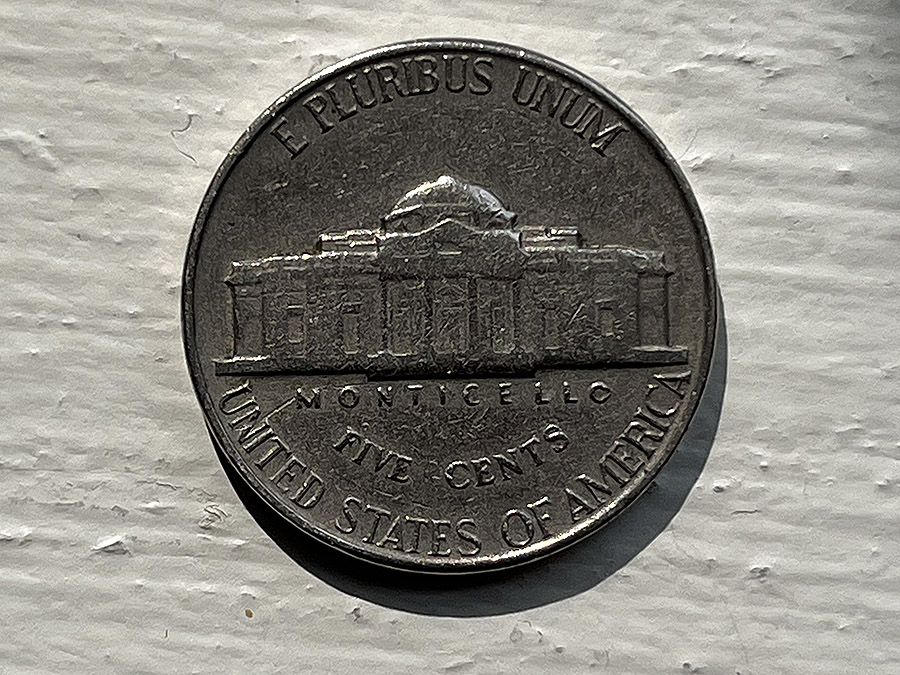
This was the oldest one I found in that collection. I looked it up. According to the web, a 1957 nickel could be worth a few thousand bucks, or about five or 10 cents. Guess which one I’ve got. They’re all worth a nickel, unless you find a sucker.
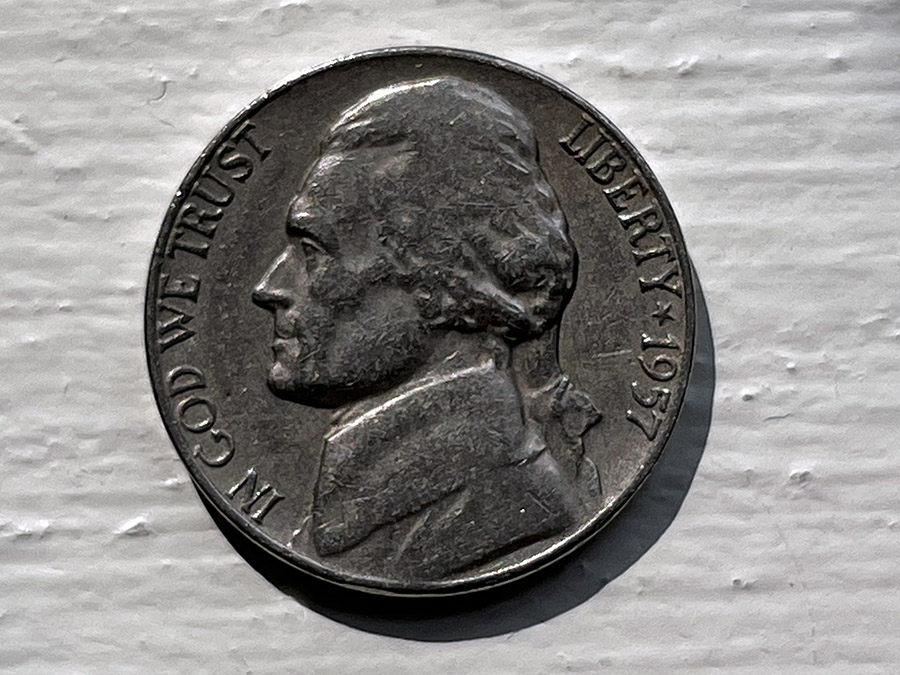
Jefferson’s war nickels, the ones produced between 1942-1945 can be worth a bit, depending on the specifics. Because of war rationing they were minted with 35 percent silver. When was the last time you saw a coin from the mid-40s? And are you prepared to say mid-nineteenforties? Guess we’ll be doing that soon.
I began to wonder if you can solder coins. Some of these could be some sort of art. (Turns out you can solder coins.) It’s not as if they are doing anything else, sitting in these little glass containers.
I was doing this because I had the time, I guess. My chief task for the day was keeping two electricians hydrated. These two guys came out today to do some electrical work, obviously. We are having a generator installed. The unit itself was brought in today and put on a little slab on the southwestern corner of the house, because that’s where the gas meter is. The electric comes in on the northeastern corner.
The problems are there are some tight spaces, some old DIYesque wiring, the solar panel configuration, incredibly hot temperatures, and horrible air quality. These poor guys, we invited them inside to cool off several times.
I kept them in ice water all day. I offered them giant umbrellas for shade. There’s no need to suffer, but theirs is outdoor work. Mostly, anyway. I think they’ve been taking refuge in the basement, where it is nice and cool, and where everything will be connected, gas to electric.
They’ll be back out to continue their work tomorrow. It’ll be just as hot or worse. They’ll have to disconnect the power for a while to finish their work.
Also the air quality will be poor. Also, they might not finish tomorrow. These poor depleted guys.

We saw the Dave Matthews Band Saturday night. Third summer in a row. I think this is the fifth or sixth time I’ve seen them over the years. We go to this show because my godsisters’-in-law (just go with it) do a DMB pilgrimage every summer. They invite us to the show closest to us. They tailgate with their old school buddies and friends and we get to tag along.
At some point the joke became that I don’t like Dave Matthews and I must have reacted just right, because that joke persisted. Later, I came up with a brilliant reply. I’ve been waiting for someone to ask me my favorite Dave Matthews song, so I can say “I like that Ants Running song.” As a joke it’ll work on several levels. I have the name wrong, and some of the longtime fans are over it, including one of my godsisters-in-law.
This isn’t that, but rather a bit of a meandering horn section, just for fun.
They played Ants Marching. I turned to my godsister-in-law at the end and said, “I like that song. They should put that on the radio. That’s got pep!”
She was not amused with my joke, but she had a great time at the concert, and so did all of the fans, even me. I like the band just fine.
Poison ivy update: today marks three weeks from my careless self-exposure. Tomorrow marks three weeks from the first itchy symptoms. I am much improved — which is to say healing, not healed. Eventually I worked it out to alternating between Calamine and cortisol. I also had a few very long oatmeal bath soaks. Now, my skin is mostly dry, itchy, flaky, or some combination.
Also, I found some on a tree while puttering about the yard. I dealt with that one in a much more sensible manner.
In short, I will survive, but the ivy probably will too.
The actual poison ivy vines I plucked, meanwhile, have surely returned by now.

Enjoy a nice little solo ride this evening. My lovely bride was off doing a workout elsewhere and that let me visit some lovely little roads at my own pace.
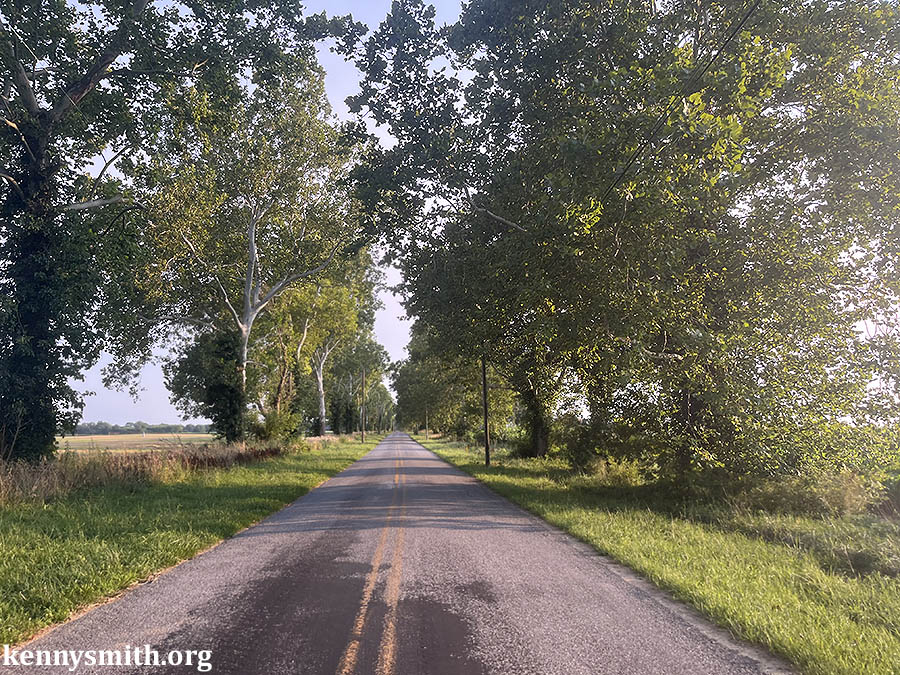
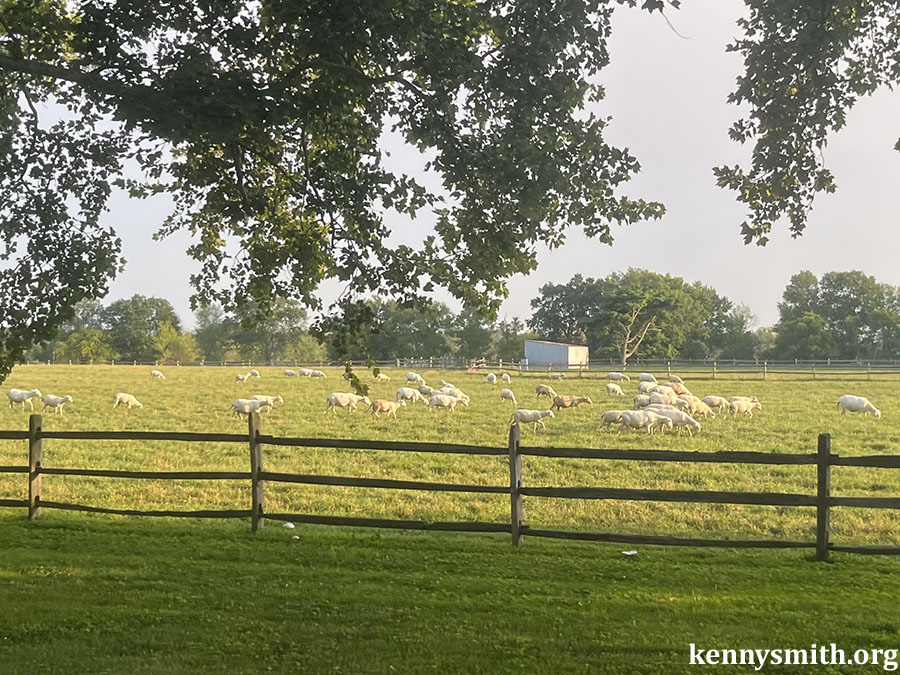
I made some new sheep friends. They couldn’t even be bothered to look up as I soft pedaled past their evening graze.
The corn is coming along nicely. Took me three tries to get this photo, and it wasn’t quite what I wanted.

The chores never end in farm country. I wonder what else this guy could be doing right now. I wonder if he’d rather be pedaling around, like me. I think most people would rather be riding a bike than doing evening work. Then again, combines aren’t connected to bikes.

Sometime after that I dropped a water bottle — a fate worse than dehydration. So I had to turn around and fetch it. Stop, put your foot down, wiggle the bike around and coast a few feet the other direction. Then bend waaaaay over to the ground without hurting yourself. And then you stab yourself with greasy gears.
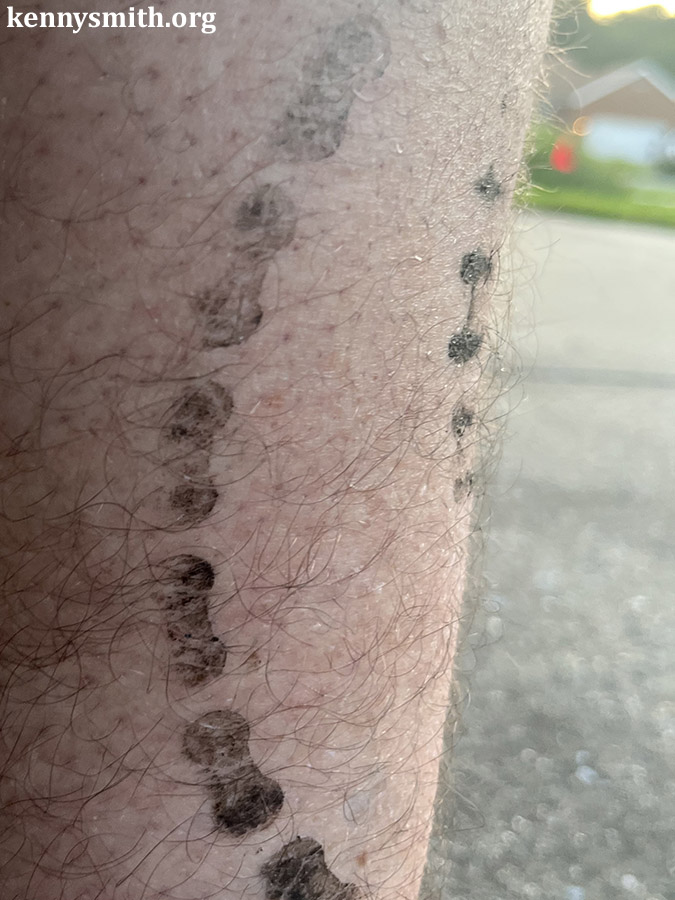
I have joked that I should just get that as a tattoo and save myself some time. I won’t, but then again it has been a while since I gave myself the ol’ grease tattoo, too.
I wore a new jersey today, a loose fitting number, which was perfect for one of those days when it didn’t matter that everything clung to me. And on the back of the tag …
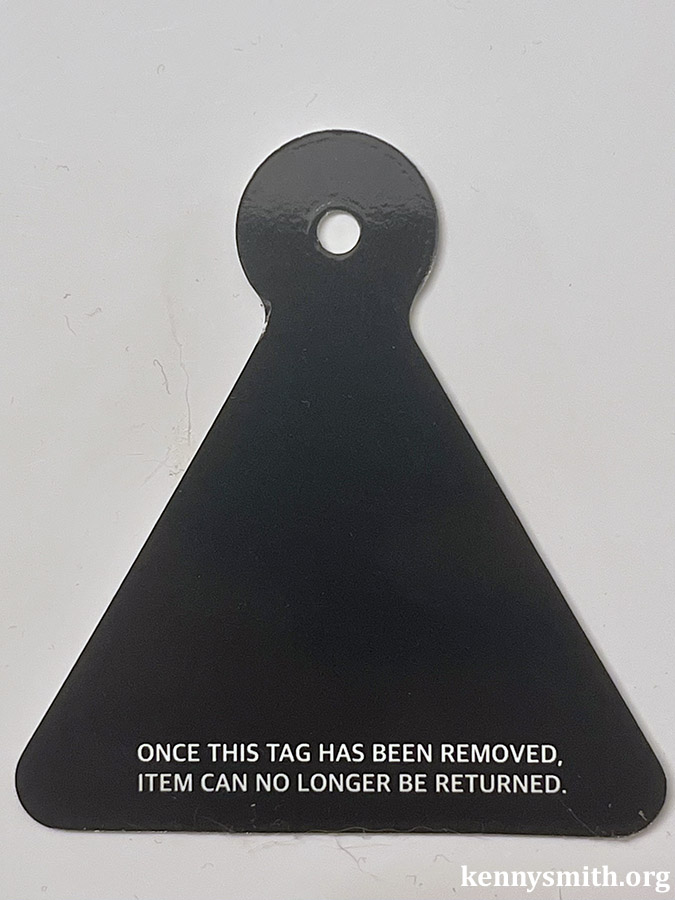
Sure, now you tell me. Good thing it fit.
It’s actually too big, but I took that tag off.
One last clip from the Guster show, last Friday. Their alt-breakthrough, now 28 years old (that was a great time to be listening to 99X), somehow, fell off the live show list for a long time. I guess you get tired of playing the same things every night at some point. Also, the ping pong balls were probably becoming a problem. (People used to throw them onto the stage at the end of the song. It makes sense with the song, moreso than having to bring the things into venues, I’m sure.) Also, you have other things you want to play. Or maybe you’re just looking for ways to do old things. I think they called this version Airport Song 2000 for a while. It has an entirely different feel.
I wonder if they’ll have another re-instrumentation for the 30th in 2028.
Anyway, great show Friday night. I’ll put up a little clip of a DMB song from Saturday’s show tomorrow. Also, we’ll be talking about generators.
Without hesitation I can say that the highlight of today was updating my university password. Passphrase, actually. This must be done every six months — if the system remembers it. (It doesn’t always seem to remember it.) But, without fail, in those times I must update it, I always find myself in a struggle. You log in to things several times a day and your fingers get into habits. And then, of course, it is time to update the password. Passphrase. Except I’ve noticed the last two times that the requirements have continued to grow expansive.

I use a sentence, and my now expired passphrase included a special character and a number. Now I have to make sure the new passphrase checks all of those boxes.
Hilariously, the form field where you input this does not show the characters you are typing, just the little privacy dots, as if my books or my cats are going to steal the new password. Passphrase. So you better get it right. Of course, it must be confirmed. And you better write this down. So I have it written down in a place where only I will find it. Because security.
We all remember the Instructure debacle of 2026, after all.
And now I will have to retrain my fingers to type this new phrase. Hopefully I’ll be in shape before I have to do this in front of students. Nothing builds confidence in the classroom like messing that up three times in a row.
Also, when you have completed the not-at-all challenging task of designing a new passphrase and making sure you’ve met all of the criteria now involved you are encouraged to update this in the places where it needs to be updated.

Because no one remembers the Instructure debacle of 2026, after all.
It’d be nice if every place where you had to login to something had committed to the same series of special character challenges, but that’s a lot to coordinate and keep straight, of course. And all of this is just another step toward my computer having a fingerprint pad on it, at which point I will retreat to Walden.
We saw another show Saturday night. I’ll give you four hints.

The second hint is that this act was at a different venue, a much larger venue. (Don’t worry, we won’t go through the naming origins this time. OK, fine, it is named after an 18th century British lawyer.)

The third hint is that this band is marking the 30th anniversary of their first Grammy, which is to say they’ve been around for a while. And, in that time, they’ve cultivated and maintained quite the following.

OK, final hint, if a bit in profile.

It was Dave Matthews Band, which we have seen a few years in a row now, attending with friends. All told, I think this marks the fifth or sixth time I’ve seen them over the course of their touring career. If you like them, they put on a good show. If you like jam bands, they put on a good show. If you’re just determined not to like them, you probably won’t like the show. I feel like I always come away from the show thinking the appreciation outpaced the expectation just a bit, whatever that means.
I think what it means is that I’ve seen several bands and singers more than a few times and I’ve decided there are only so many you need to see more than a few times. And, if I had to make a list, I wouldn’t put DMB on that list, but when I leave the show I find myself thinking, That was a good time. Because it is!
It isn’t that it is a surprise, but what is surprising is that they’ve built up this huge legion of concert followers over the many decades and they continue to put up shows with enough energy and fun that people keep coming back, dozens and dozens of times.
I wonder if Dave and his buddies thought about that way back when. I wonder if anyone does.
Take Guster, for example. We saw them Friday. Next year they’ll mark the 30th anniversary of the record that turned them into a regular airplay band. I know they’ll celebrate that because Friday night they mentioned that this is the 20th anniversary of a subsequent record. The threesome met in school, at Tufts. No way they sat around on campus in 1991 and said, “Man, I hope one day we’re filling stage banter with an ad lib about the region we’re touring in when we are 53 years old!”
Maybe that’s the dream. Do something you love with people you like and get to do it so long and so well that you can also pursue other things you are interested in, too. I’m certain that’s the dream, actually. But no one says that at 18. No 18-year-old has the foresight. (Shoot, I was 26 when I figured it out, and I’ve spent the years since wondering if I actually did.)
Existentialism is definitely going to be incorporated into my next password. Passphrase.

