09
Oct 26

Oct 26
The 1936 Glomerata, part four
We go back once more some 90 years into the past for a few more glimpses at the people haunting the steps of my alma mater. It was the Great Depression. It was 1936. (Part one is here. Part two is here. Part three is right here.) This is hardly a complete look, but there’s a lot to find in 1936. Let’s see what is inside.
What is today the War Eagle Battalion traces its origins back to 1916, when President Wilson signed into law the Natioanl Defense Act. That gives us the modern ROTC, but the university’s military training program goes back to some of the earliest days of the institution and draws a line from Morrill Land-Grant Act. Back then, all males attending Auburn had to participate in the program for at least two years.
It hasn’t been compulsory for decades, but today it is a four-year program with cadets graduating as junior grade officer going into active duty, the national guard, or reserves.
Auburn University has produced more than 8,000 Army commissioned officers. Among the graduates include Ralph “Shug” Jordan ’32, who would invade Europe in between stints becoming a legendary coach, Rep. William Nichols ’39, Astronaut Jim Voss ’72, NFL Hall of Famer Kevin Greene ’84, Olympic Gold Medalist Ruthie Bolton ’89, and, even in this book, a few important future generals.
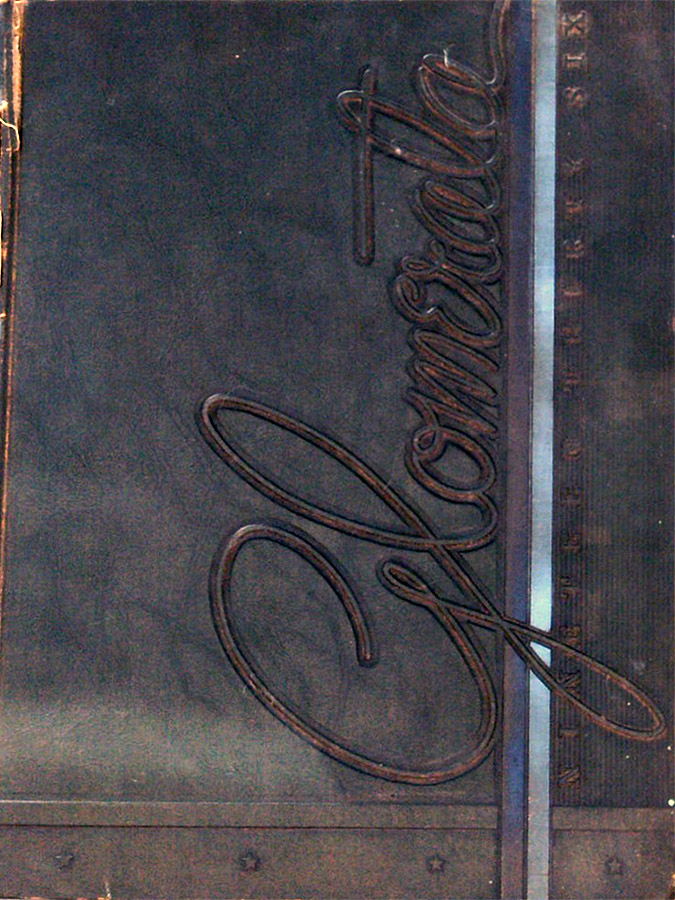
But, first, here’s the cover.
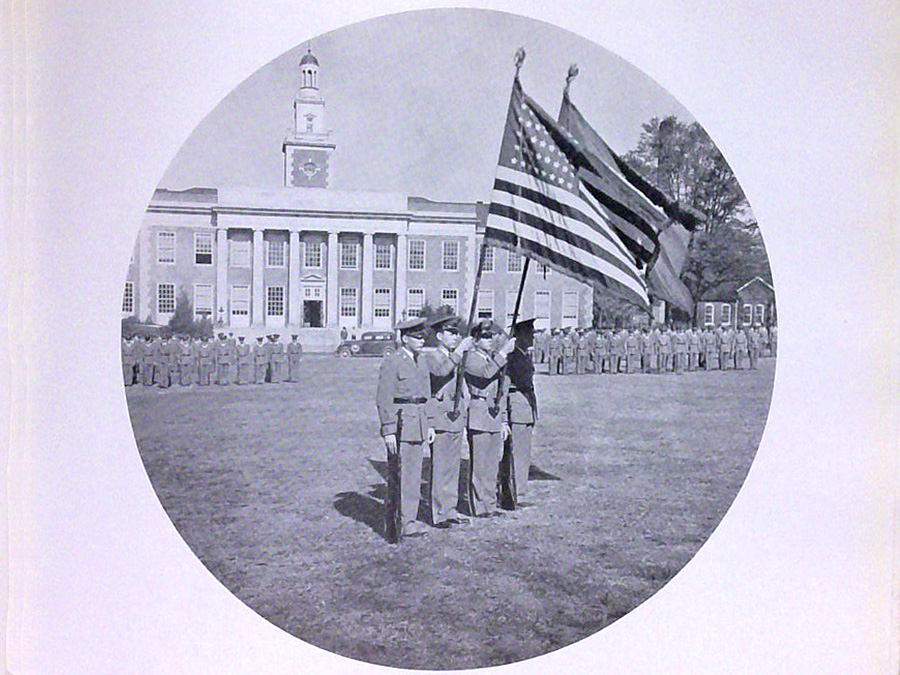
It’s a short little section, so we’ll try to concentrate on finding out who a lot of these people are. But, first, here’s a parade shot.
They’re standing in front of Ross Hall, which is still at the center of things. I can’t get in that exact spot on Google Maps, but here’s the view. You can scroll around through here a great deal, if you like.
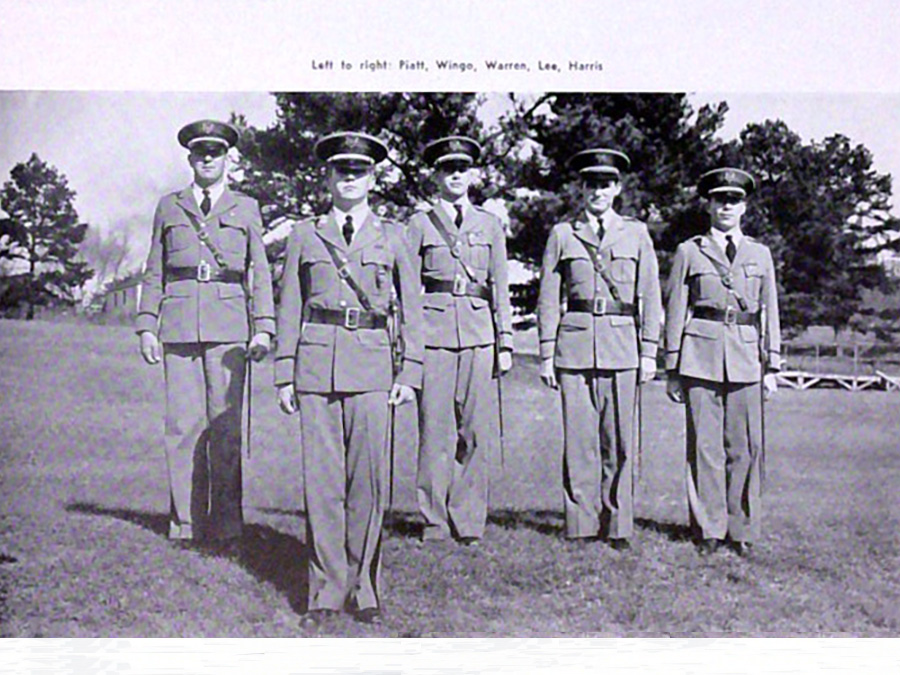
Here’s the cadet brigade staff, commanded by Cadet Colonel W.T. Wingo, Jr. He’s second from the left in this formation. We met him recently: William Taylor Wingo was a chemical engineering student from Birmingham. After school he became a Marine. By 1942 he was one of the Corps’ youngest majors. He fell ill in Samoa that year. They flew him to California, but he died there, apparently of pneumonia, just before Christmas, leaving behind a wife and young daughter.
On the left is William C. Piatt, an aeronautical engineering major from Birmingham. He would stay in the army for a while, and was a major in the artillery by the time World War 2 was over. He married a Mississippi girl, and they built themselves a life there. She worked in real estate and owned a dance studio. They were prominent members of their community. He was remembered, when he died at 64 in 1974, as a pioneer in air conditioning — and that’s saying something in the Deep South. His wife survived him. When she passed away at 79 in 1998, they had a son, two daughters, seven grandchildren and one great-grandchild.
Carl K. Warren, Jr., in the back, was a science and literature major from nearby Opelika. He fought in the war, received the Silver Star while in the 4th Infantry Division. Sometime soon after he rose to the rank of lieutenant colonel and took a post at the U.S. Military Academy. His wife died while they were stationed in Hawaii in 1959. She’s buried at Arlington. It looks like he remarried. What became of him after that I can’t say.
Eugene Lee was a civil engineering major. He married a Birmingham Southern grad in 1940. He served in World War 2 and in Korea. He worked at Tennessee Coal and Iron, which was, at that time, busy building a certain reputation, shall we say. He died in 1988, at 76. His wife made it to 89, and passed away in 2002. They’re buried Fort Logan National Cemetery, in Colorado.
Herman Harris was a business student from Clanton. While he was a captain of the ROTC, he was also the business manager of The Plainsman. We met him a few weeks back. He became a brigadier general in the Air Force, finally returned from the uniform in 1971. While in the reserves he was an auditor and inspector for General Motors, ran small businesses in south Alabama and a good-sized farm. He also ran a hospital, from 1963 until he died there in 1974. People remembered his role with the local Little League, as president of the Chamber of Commerce, the Rotary, the Red Cross and Community Chest. He was survived by his wife and three adult children.
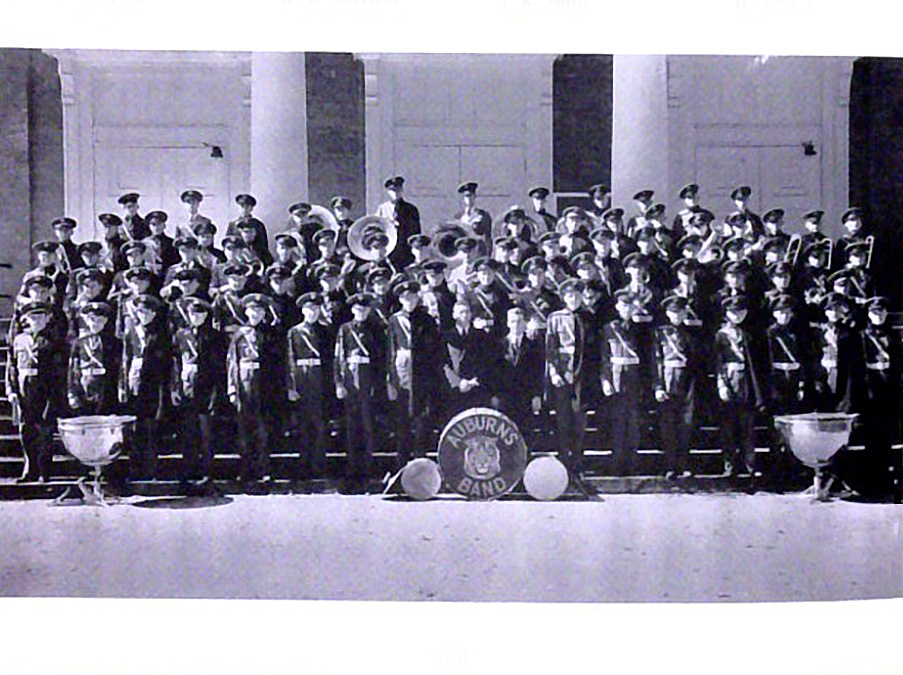
This is listed as “The Auburn Band.” It’s included in the military section, which probably makes sense for the time, even if we associate them with sports today.
There are 83 members listed. There in the center is the band’s director, Paul “Bedie” Bidez. A generation before he’d been a captain and 175 pound fullback on some of the great early teams. By this point he was coaching and running the band, which marched under his direction for 32 years. The modern band has 380 members. Almost as many members of today’s band are music majors as those in the picture, above. Bidez deserves a bit of credit for that. He founded the music department.
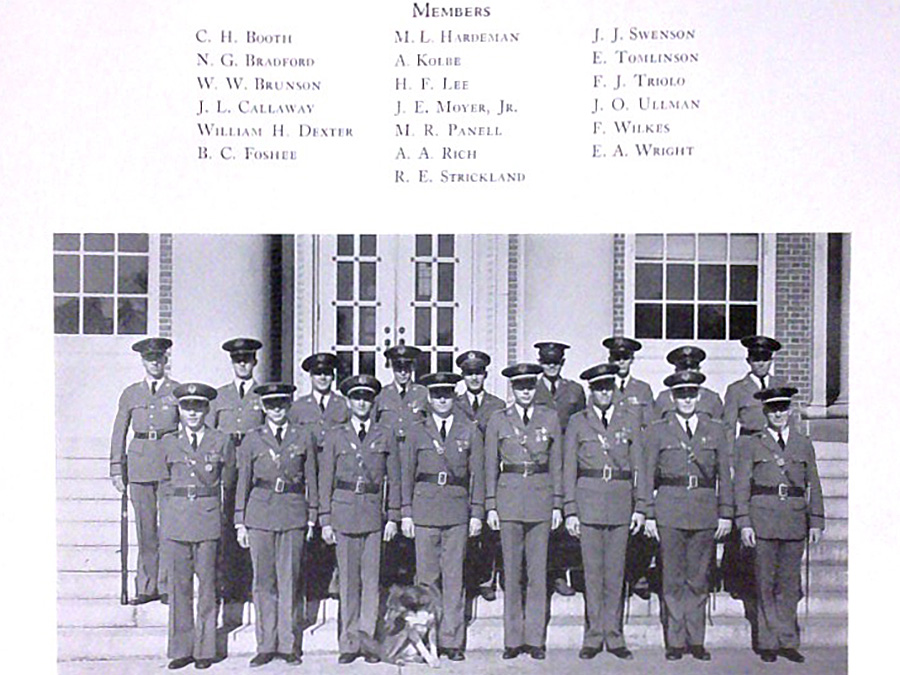
And here’s the rifle team. They’d won the conference championship the year before. The team was looking forward to hosting the championship this season. The program was expanding, too. They were coached by Lt. William Ehrgott, who came from the Military Academy, MIT, and the French Tactical School. He was an engineer before becoming a professor of military science and tactics at Auburn. He was there for four years. He was in North Africa in 1942, later becoming a staff engineer in the Ninth Air Force, rising to chief of staff as they fought in Europe and North Africa. His billets would grow more impressive as his career marched on. He was promoted to brigadier general in 1952. Probably it was all the lessons he learned from this rifle team.
The SEC doesn’t keep records of ancient rifle championships online, unfortunately. I’ve been pouring over the campus paper for a few minutes and other state publications, but can’t find anything elsewhere that tells us how they did particular season. I do know that later in 1936 it was announced that the university would create a co-ed rifle team. That had to be pretty exciting for the 1930s.
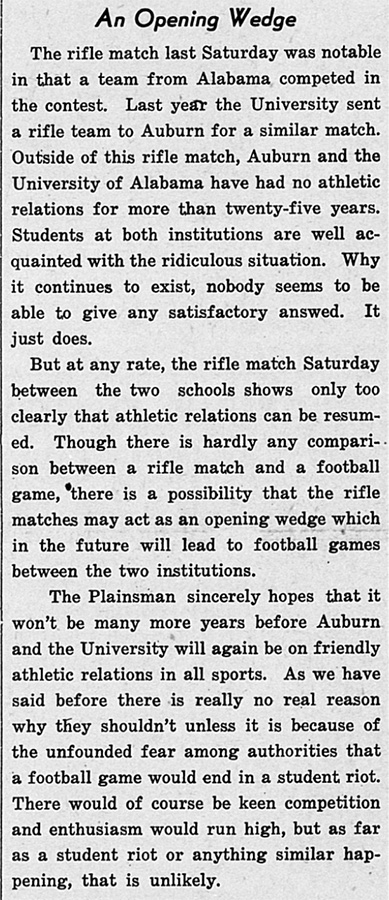
Also, I found this, in a March issue of The Plainsman.
They were mistaken here about “no athletic relations.” The two schools met in basketball for the first time in 1924, for example. There may be other sports where the schools tangled, but history is a challenge for the athletic department and I don’t want to spend all night on that. We do know they’d not played in football since 1907. We know why they weren’t playing. They did, too. It’d be a dozen more years before the football teams faced off again, in 1948. The state legislature would have to strongly motivate the two schools to make that happen.
But, as you’ll soon see, even without their greatest rival, the Tigers would have plenty of competition. Next week, we’ll talk athletics.
All of this will wind up in the Glomerata section (eventually). You can see others, here. Or maybe you’d like to click through to see all the covers. The university hosts their collection here.